

WHY CEXs ARE DYING
The Ones That Did Not Pivot Are Disappearing. The Exchange Era Is Ending. The Brokerage Era Has Begun.

Discl: Originally published July 30, 2026 on Jenny Q. Ta’s LinkedIn
By Jenny Q. Ta
Founding GP and Chief Strategist, WEAL28H. Former market maker. Founder and former CEO of two registered broker-dealer and investment banking firms with Nasdaq market-making operations.
Download FREE PDF: HERE
Others put research behind paywalls. WEAL28H releases ours for FREE. Our clients come through referrals, and we earn through advisory work, NOT subscriptions.
Enjoyed our analysis? Subscribe to the WEAL28H Briefing Newsletter and follow Jenny Q. Ta.
Additional infographic cards on Instagram: @WEAL28H
Listen to the audio version here:
A WEAL28H RESEARCH PAPER | The third installment in WEAL28H’s 2026 market-structure series, following CLARITY Is Wall Street’s Bill, Not Crypto’s (May 2026) and POST-CLARITY: Pivot or Die (June 2026).
A WEAL28H Research Note. Originally prepared for WEAL28H’s institutional clients, now made public.
July 30, 2026. Market and regulatory figures as of late July 2026.
Where We Stand (Please Read This First)
This piece analyzes the wave of centralized exchange wind-downs announced in 2026, using BitMart and BitMEX as primary case studies, and names several operating exchanges in a public-facts scorecard: Robinhood, Coinbase, Kraken, Crypto.com, OKX, and Binance. Three things need to be said plainly before anything else.
• First, nothing in this piece asserts or implies insolvency, misconduct, fraud, or risk to customer assets at any named firm. Every factual statement about a named company is drawn from public reporting, regulatory materials, or the company’s own statements, and is cited in the Sources section. Every conclusion beyond those facts is our opinion, applied through the framework this piece builds, and is labeled as such.
Second, WEAL28H had direct proximity to one of these events. In the weeks before BitMart announced its wind-down, WEAL28H was in active institutional onboarding discussions with • BitMart US, and Jenny knows members of the leadership team personally. Those discussions concluded without an agreement, on structural grounds unrelated to the shutdown. We say this for transparency, because it informed our read, and out of respect: the teams we dealt with were professional throughout, and the wind-down as announced is orderly. Nothing from those private discussions is disclosed here.
• Third, WEAL28H backs Tetherball (TBALL), which appears briefly in Section IX as an example of a DEX-native structure. We have a financial interest in that one example and you should weigh that section with this in mind. Full position disclosures appear at the end.
As always, WEAL28H’s analysis is direction-neutral. This is education and market-structure analysis, not advice, and not a recommendation to use, avoid, buy, sell, or hold anything.
The Big Idea in One Minute
Within three days of each other, two established exchanges with combined operating histories of roughly twenty years announced they were shutting down. Neither closure notice cited a new hack. Neither closure notice announced a withdrawal freeze or a bankruptcy filing; BitMart said withdrawals would remain available, although some users subsequently reported delays. The public record is consistent with commercial attrition as the final failure mode rather than a new hack, insolvency, or enforcement event; this paper’s framework is our interpretation of the cause. In BitMEX’s case, that commercial decline followed years of enforcement-driven constraint, detailed in Section I. The story is not that scandal played no role in the history. It is that the final failure mode was starvation rather than a fresh scandal, and structural starvation repeats.
Four forces are compressing the middle of the exchange market at the same time: regulation turned compliance into a heavy fixed cost, liquidity concentrated onto a few giant venues, the paid-listing model broke as an increasing share of token distribution and liquidity formation moved toward launchpads, decentralized exchanges, and direct onchain markets, and the funding that used to bridge weak operators through bear markets is gone. Each force has a structural component, even though funding conditions, trading volumes, and token issuance remain partly cyclical. Together, they point toward a more concentrated and mature market structure.
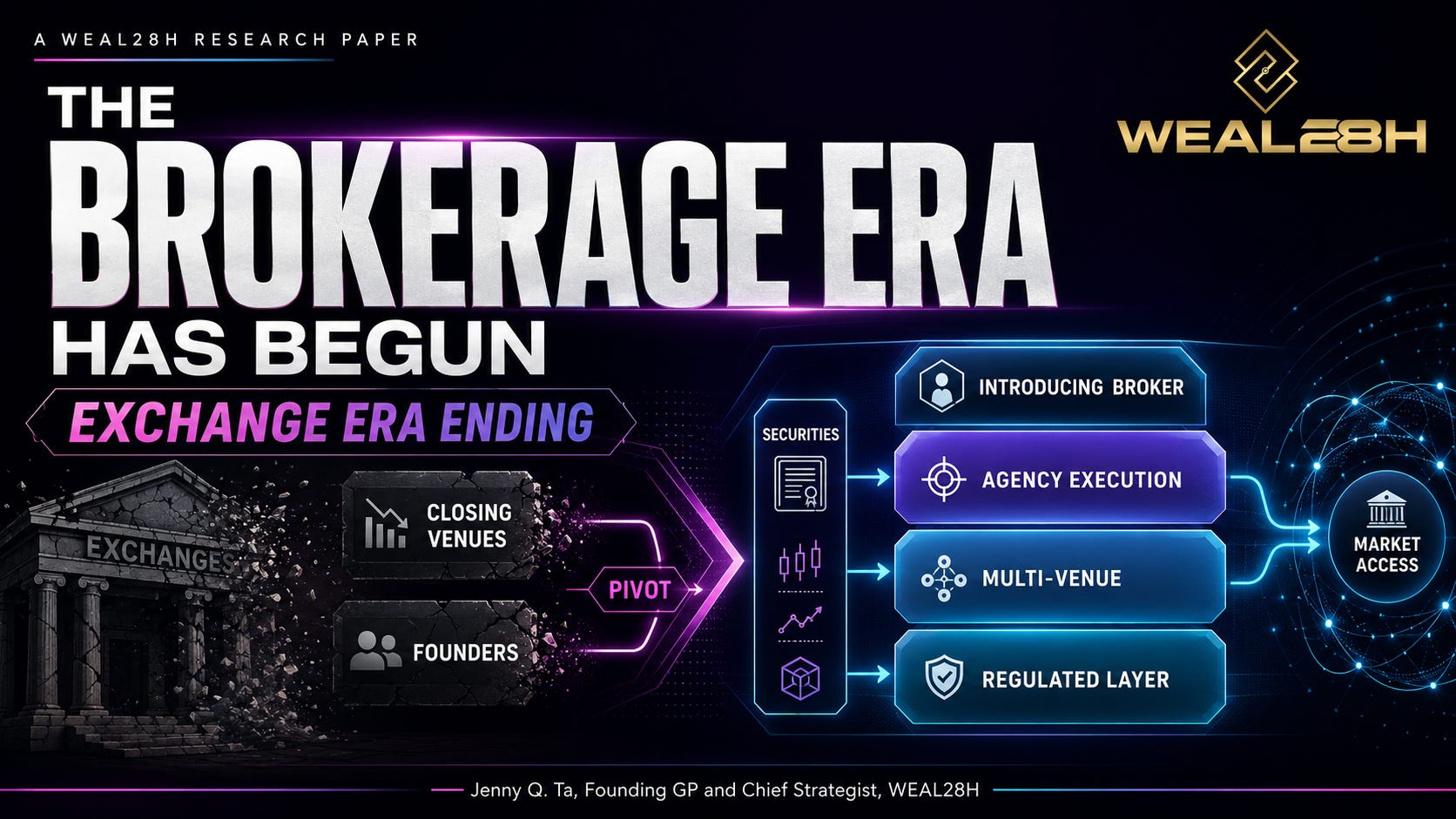
We have seen this movie. United States equities ran the same script after 2000: venues consolidated around a smaller number of powerful operator groups, while durable value accumulated both in scaled market infrastructure and in the firms that owned clients, distribution, and execution flow. Brokerages. Agency desks. Introducing brokers. Custodians. Structurers. The exchange era is ending. The brokerage era has begun. The surviving exchanges already know it: every one of them is racing to become a securities and brokerage firm. And the people walking out of the closing venues are, in our view, the natural founders of the regulated introducing-broker and multi-venue agency-execution layer crypto still lacks.
I. The Autopsies: Three Days That Ended an Era
BitMart
On July 26, 2026, BitMart announced an orderly wind-down of its entire trading platform. New registrations, deposits, and new orders were suspended at 01:30 UTC that day. All trading services cease on August 26, 2026, and the company expects to fully cease operations by January 31, 2027. The official notice cited operating conditions, market environment, and future strategic direction. No hack, insolvency, or regulatory action was disclosed in the notice.
The exchange’s native token, BMX, fell more than 55 percent in twenty-four hours, with its market capitalization collapsing from near 100 million dollars to a reported range of roughly 30 to 55 million dollars. BMX was an ERC-20 token whose primary utility was trading fee discounts on BitMart. Its entire reason for existing was tied to a platform that announced it would stop existing.
BitMart operated for roughly eight years and was widely known for one of the industry’s largest listing catalogs, spanning major, actively traded assets alongside a long tail of smaller and newer tokens. That long-tail exposure brought, by wide reporting, heavier regulatory scrutiny and a more transient user base, and on our industry-informed reading, the paid listings attached to that long tail were an important part of its business model, though BitMart’s revenue composition is not publicly disclosed. Hold that thought. It matters in Section III.
One more fact makes this autopsy remarkable: BitMart had already survived the violent era. In December 2021, attackers used a stolen private key to drain roughly 196 million dollars from BitMart’s Ethereum and BSC hot wallets across more than twenty tokens, swapping the assets through decentralized venues and routing them to a mixing service. BitMart suspended withdrawals, and CEO Sheldon Xia pledged to cover the losses from company funds. The episode drew what was reported as the Federal Trade Commission’s first known investigation into crypto markets, disclosed in an August 2022 order concerning BitMart’s operators, covering the exchange’s representations about its services, consumer account access, and data security obligations. BitMart absorbed one of the largest hacks of 2021, pledged reimbursement from its own funds, outlasted a first-of-its-kind federal probe, and kept operating for five more years. Then, on our read, the economics ended it in months. One exchange lived through both death regimes; the later wind-down is consistent with a structural commercial failure rather than another disclosed security event. That is the entire thesis of this paper in a single company’s history.
BitMEX
Three days earlier, BitMEX, the exchange that introduced the perpetual swap and once dominated leveraged crypto trading, confirmed it will permanently shut down at 04:00 UTC on September 23, 2026, following what parent HDR Global Trading described as a strategic review. As of July 2026, BitMEX’s daily trading volume sat near 400,000 dollars, less than one hundredth of one percent of the market. Its BMEX token fell over 90 percent on the news, to an estimated market capitalization of roughly 497,000 dollars.
Read the coverage carefully, because the absence is the headline: no announced balance-sheet hole, no announced withdrawal freeze, no bankruptcy filing. Traders migrated to deeper liquidity elsewhere, and its extremely low reported trading volume makes the closure consistent with a business that had become too small to sustain, although BitMEX did not disclose its complete internal analysis. A former giant failing without triggering a financial crisis is a signal worth reading.
One piece of history belongs in this autopsy, because leaving it out would make the story cleaner than the record. BitMEX’s decline did not happen in a regulatory vacuum. The CFTC and Department of Justice brought actions against BitMEX entities and founders beginning in October 2020. BitMEX entities were ordered in 2021 to pay a 100 million dollar civil monetary penalty, with up to 50 million dollars offset by payments under a related FinCEN resolution. All three co-founders pleaded guilty to Bank Secrecy Act violations in 2022; in separate CFTC consent orders, they were required to pay 10 million dollars each in civil penalties. The company pleaded guilty in 2024 and received a separate 100 million dollar criminal fine in January 2025. The 2026 closure involved no newly disclosed enforcement action, insolvency, withdrawal freeze, or disclosed loss of customer funds as of this paper’s cutoff date. But on our reading, the enforcement history materially contributed to the commercial starvation that followed. The offshore, high-leverage model that made BitMEX dominant became a regulatory liability, and the venue never regained its former position. That is not a weaker version of this paper’s thesis. It is Section VIII’s argument, regulatory arbitrage flipping from asset to liability, written out in one company’s docket.
They Are Not Alone
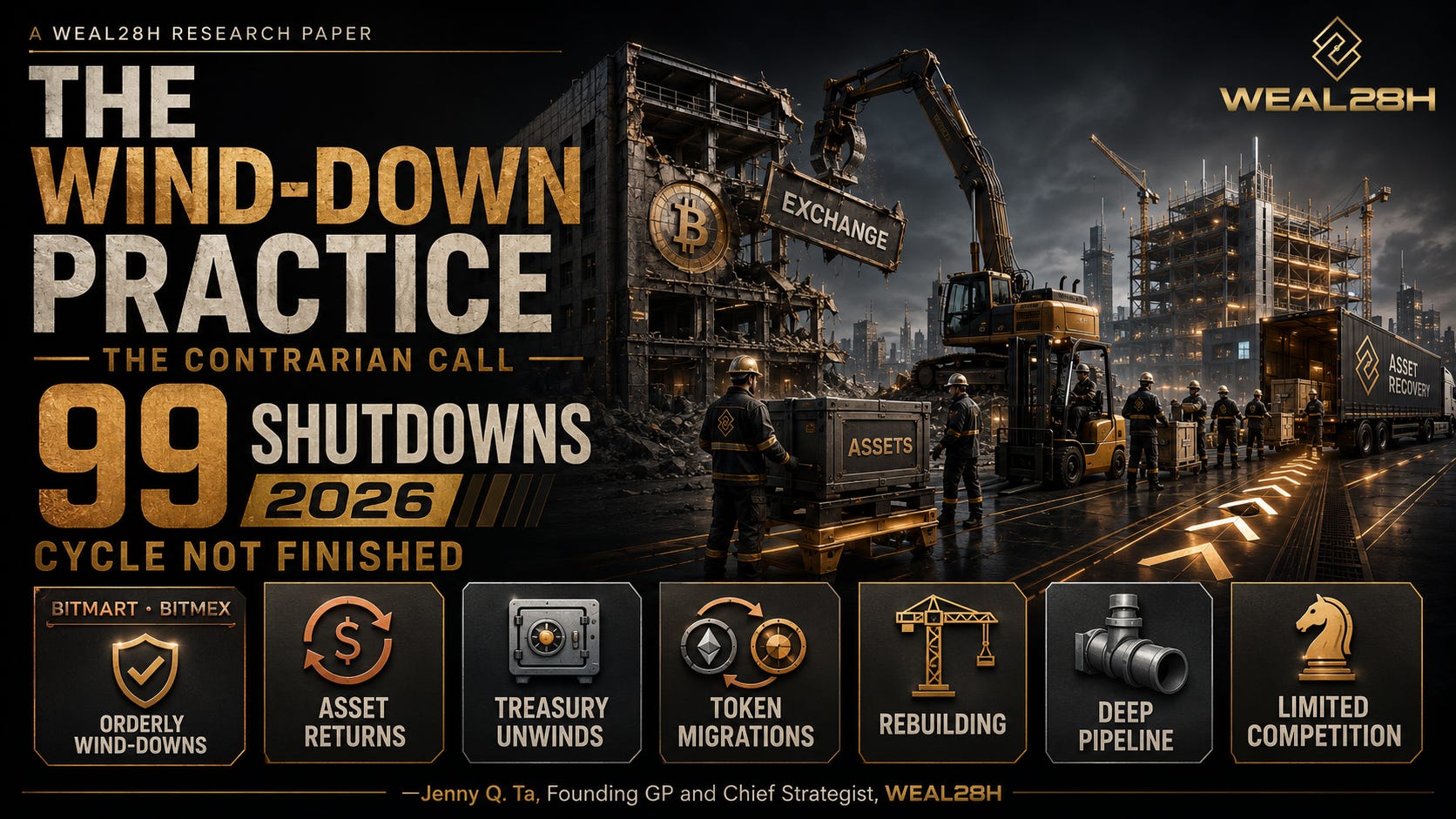
RootData counts 99 crypto project shutdowns in 2026, and the list includes centralized exchanges BitMart, BitMEX, and AscendEX alongside wallets, DeFi protocols, lending platforms, and developer tools. That is a mixed population of very different businesses, so we cite it for breadth of the contraction, not as an exchange-only sample. Industry analysts note the scale of closures has surpassed the 2022 wave, but without the systemic contagion of FTX or Terra. Meanwhile, first-half 2026 saw 207 hacks and 972 million dollars stolen: the industry’s visible risk mix is shifting toward code and custody failure. The venues examined here are not blowing up through disclosed fraud or balance-sheet failure. They are being priced out of existence.
II. How They Died Is the Story
Every prior crypto bear market killed exchanges, so the question in this paper’s title deserves a precise answer. Mt. Gox died of theft in 2014. The 2018 to 2019 winter cleared out the ICO-era long tail. The 2022 collapse took FTX, Voyager, Celsius, and BlockFi through fraud and leverage. Those were violent deaths: sudden, criminal or reckless, and contagious.
2026 is different in kind. BitMart and BitMEX are dying rationally. The announced wind-downs are consistent with management concluding that continued operation was no longer economically attractive, although neither company disclosed its complete internal analysis. An announced orderly wind-down with a published timeline is what mature industries do when a business model expires; whether the execution matches the announcement is a separate question that only the completed wind-down will answer. The two cases are not identical, and the difference matters. On our reading, BitMart is the cleaner starvation case. BitMEX is a hybrid: a commercial closure at the end, after years in which enforcement materially constrained the offshore, high-leverage model on which its dominance had been built. It is also what makes this wave more important than the violent ones, because scandal is idiosyncratic while starvation is structural, and even the hybrid case ended in starvation rather than in a new scandal. What starved these two venues is, on our reading, starving every venue with the same profile, at the same time, for the same four reasons. To be precise about epistemics: the companies’ disclosures establish that the closures happened, not why. The four forces in Section III are a framework consistent with the public record, not a causal proof, and we present them as our interpretation.
We should name the consensus view before we argue with it, and give it its strongest form. This wave is unfolding inside a severe market downturn, and the strongest cyclical interpretation is that exchange closures, funding droughts, falling volumes, and weak paid-listing demand have accompanied every prior crypto winter and later reversed when prices and risk appetite recovered. Much of the commentary reads this wave exactly that way: every cycle flushes out the weak, the way 2022 flushed FTX, Celsius, Voyager, and Three Arrows, and the flush is a healthy prelude to the next leg higher. We agree it is healthy. We disagree that it is cyclical. The 2022 casualties died of fraud and leverage, which are behaviors, and behaviors return every cycle. The 2026 casualties are dying of compliance floors, liquidity gravity, a broken listing pipeline, and a closed funding window, which are structures, and structures do not reset when price recovers. The structural claim is not that cycles disappeared; it is that regulation, liquidity network effects, and changes in token distribution now prevent the same mid-tier venue population from rebuilding when the cycle turns. Our claim, stated so it can be scored: the mid-tier venue population does not come back in the next bull market. If dozens of new mono-line exchanges launch and thrive in the next up-cycle, the cyclical camp was right and we were wrong. We do not expect to be wrong.
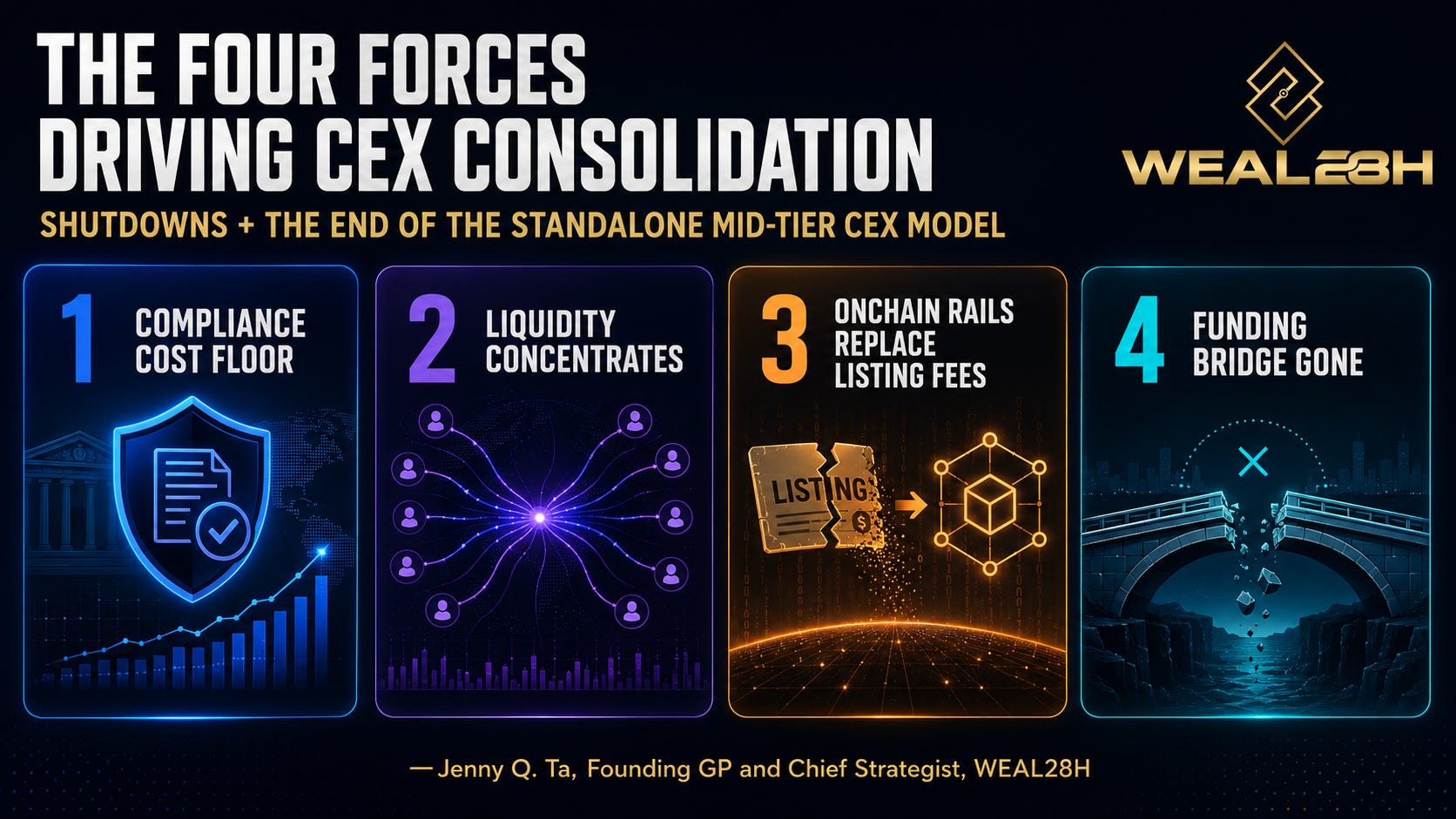
III. The Four Forces
1. Regulation turned compliance into a heavy fixed cost
In 2015 or 2018, a small exchange could hibernate through a bear market: skeleton crew, offshore entity, minimal compliance spend. That option no longer exists for any venue that touches regulated markets. MiCA authorization in Europe, state money-transmission regimes, licensed settlement partners, institutional KYB and CDD stacks, audits, and surveillance standards are fixed costs that burn whether or not anyone is trading. The GENIUS Act adds a coming layer: the statute was enacted in July 2025, its principal obligations take effect on the earlier of January 18, 2027 or 120 days after the primary federal regulators issue final implementing rules, and while those obligations were not yet legally operative as of this writing, firms were already incurring preparatory legal, systems, reserve, and governance costs against them. The CLARITY architecture, which remains proposed legislation rather than enacted law as of this writing and whenever it completes, raises that floor further by design: federal registration, national custody standards, market surveillance, and industry-funded supervision.
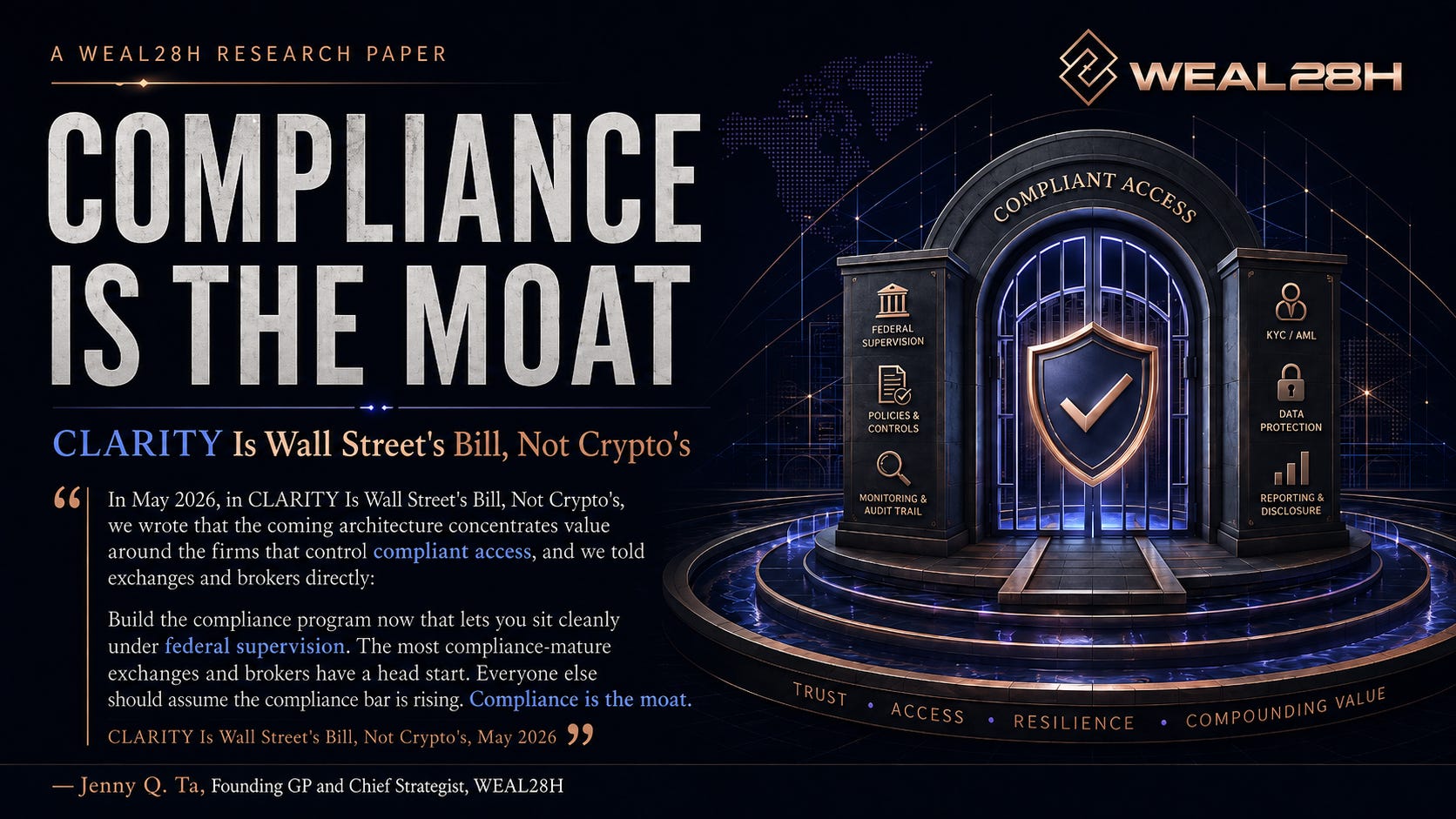
A fixed compliance floor changes the survival math completely. Revenue below the floor means the rational move is not hibernation but wind-down. In our May paper we wrote that for exchanges and brokers, compliance is the moat, and that everyone should assume the compliance bar is rising. The corollary we can now state from the evidence: a moat you cannot afford is a moat you drown in.
2. Liquidity concentrated, structurally
In previous cycles, retail had nowhere to go but exchanges, so even small venues kept a customer base. Now retail reaches Bitcoin through spot ETFs in an ordinary brokerage account, and institutions route through prime brokers and a handful of dominant regulated venues. Reporting through 2026 shows user activity consolidating around a small number of platforms while volumes fell sharply: combined centralized-exchange spot and derivatives volume declined 11.7 percent in April 2026 to 4.61 trillion dollars, the lowest since September 2024, while monthly spot volume alone fell to roughly 1.05 trillion dollars, its lowest in more than two years. Liquidity begets liquidity. Once the top venues own the depth, a mid-tier venue’s spreads cannot compete, and its customer base does not come back when the cycle turns. That is the difference between cyclical pain and structural obsolescence.
3. The listing-fee model broke: the token pipeline shifted toward onchain rails
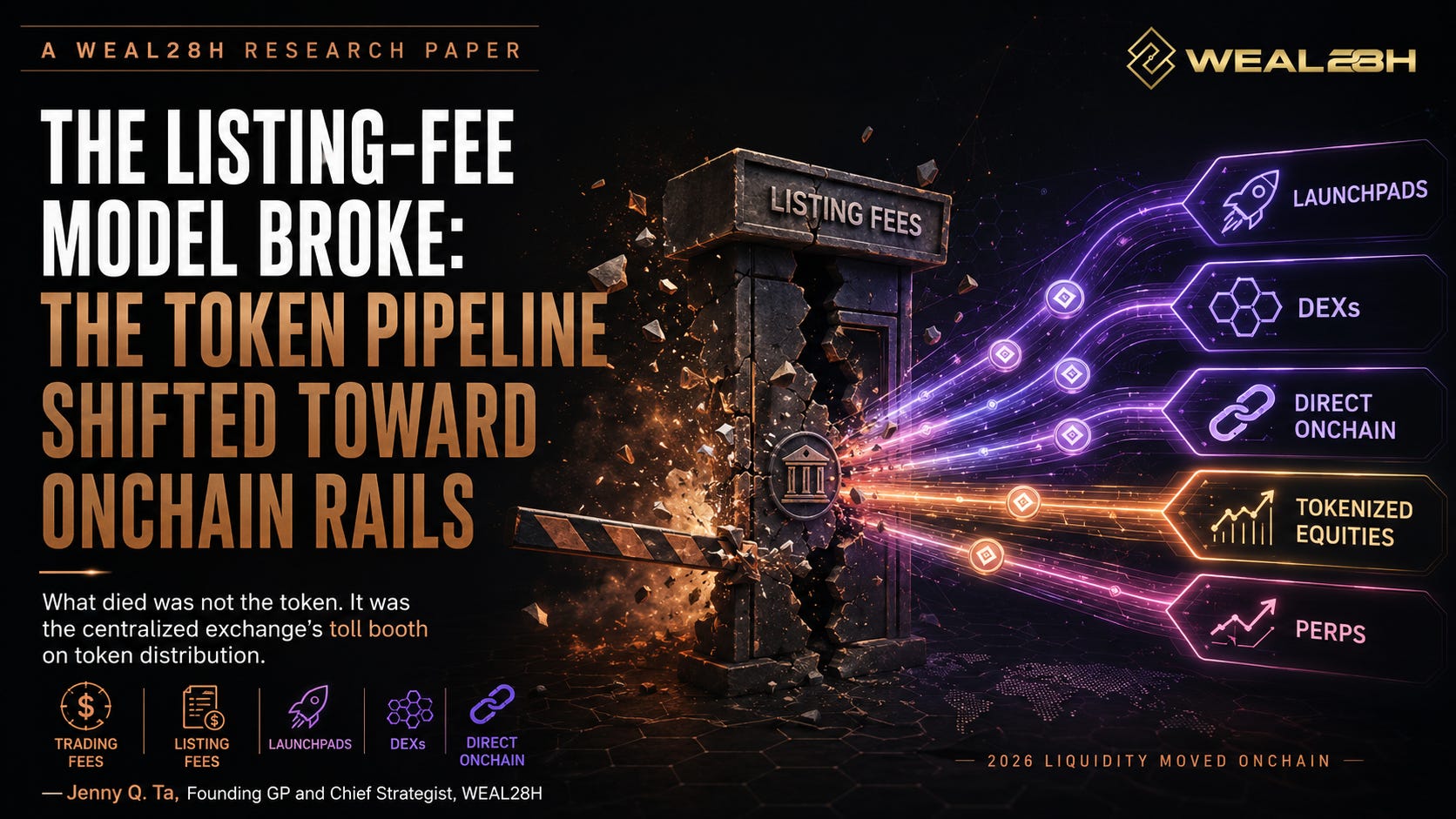
The long tail of exchanges historically lived on two revenue lines: trading fees and listing fees paid by token projects. On our reading, both broke down together. Fee wars compressed spot economics toward zero. And the paid-listing pipeline broke, though not because token issuance stopped. Empty-token issuance did not disappear; much of its distribution and liquidity formation migrated toward launchpads, decentralized exchanges, and direct onchain markets, while 2026 liquidity also moved toward tokenized equities and perpetual futures. Memecoin issuance persisted through 2024 into 2026, but it increasingly monetized on decentralized rails rather than through paid centralized listings. What died was not the token; it was the centralized exchange’s toll booth on token distribution. BitMart’s large long-tail catalog left its business model exposed to exactly that shift. When the paid-listing model lost control of token distribution, the venues that depended heavily on that pipeline lost a central source of differentiation and revenue. We predicted the repricing of the empty-token economy. The breakdown of its centralized distribution layer is the same event, one layer up.
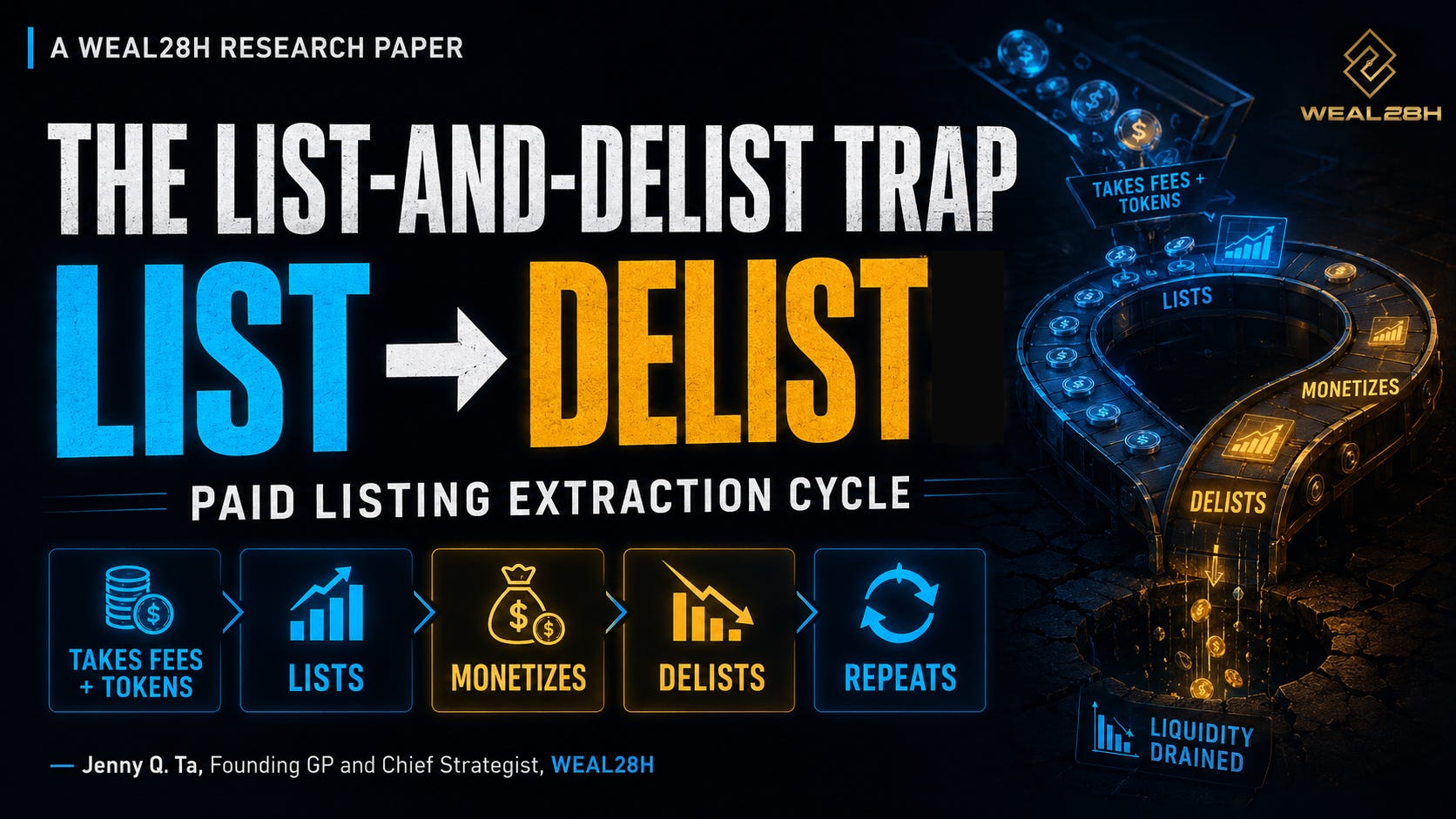
A sidebar on why this model could never have lived, not merely why it died. At the unregulated end of the market, by wide account from founders across the industry and consistent with what we have observed in our own deal flow, paid listing was often not a service but an extraction cycle: a venue takes a listing fee plus an allocation of the project’s tokens, lists the token, monetizes the allocation into the listing liquidity, then delists once there is nothing left to collect, and moves to the next project in line. We name no venue and this describes a practice, not any particular firm. But understand what the structure means economically: it is nonrecurring revenue harvested from the worst-selected customers, because the projects most willing to pay for shelf space are precisely the ones that cannot attract demand on their own, and the collateral being consumed with every cycle is the venue’s only real asset, user trust. In the language this firm always returns to: product language (we list quality assets) with no legal capacity or duty behind it, and no one in the chain accountable for what got listed. Structures without an accountability stack eventually meet a regulator or an economic reckoning. This one met both. A business whose fuel is a perpetual supply of new empty tokens has a lifespan exactly equal to the era in which that supply routed through paid centralized listings, and we published the repricing of that economy in June.
4. The funding bridge is gone
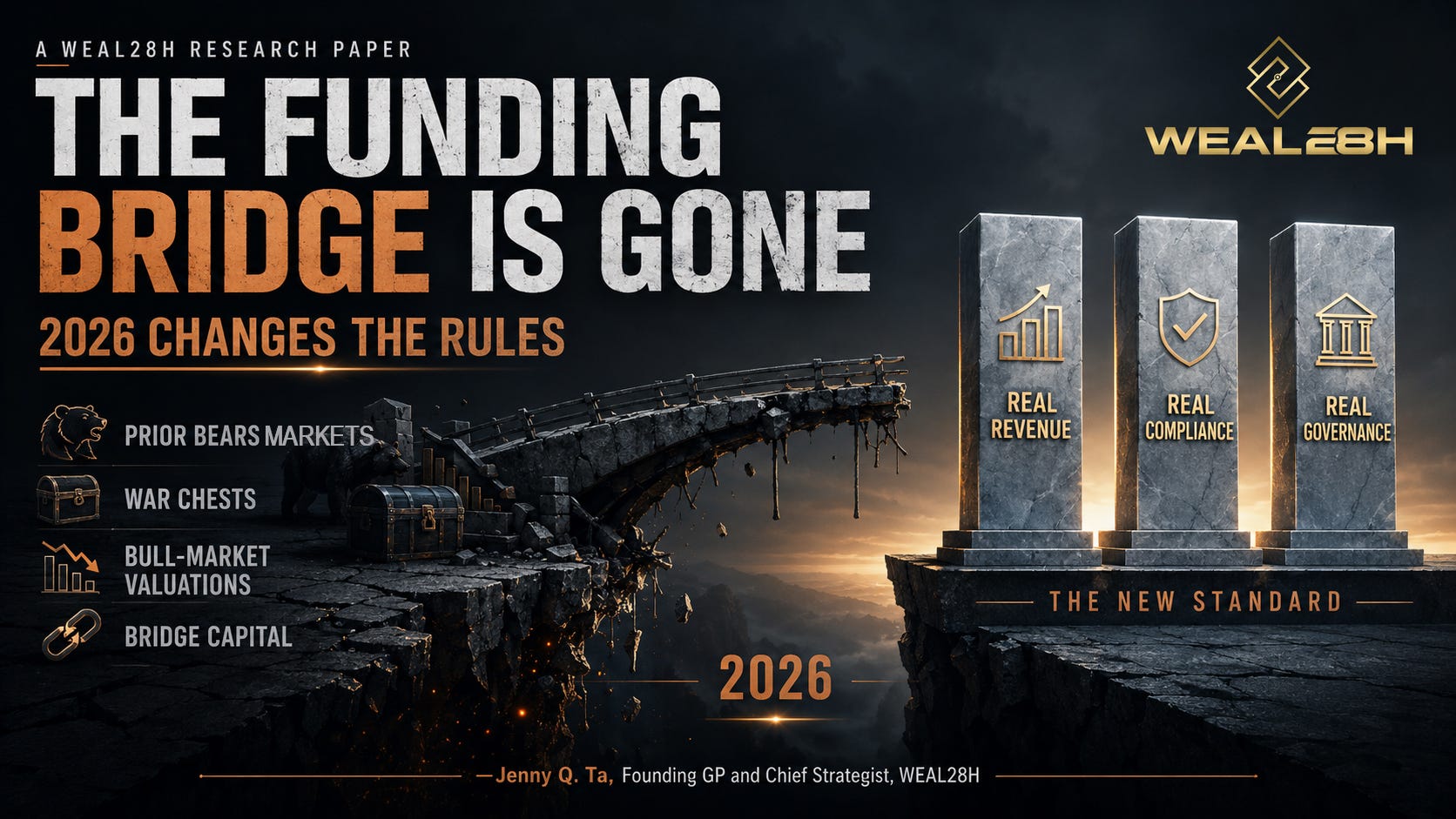
Prior bears, exchanges entered winter with war chests raised at bull-market valuations, and bridge capital was available to anyone with volume. In 2026, funding requires real revenue, real compliance, and real governance. The capital that is moving is moving up-market: Citadel Securities’ 400 million dollar investment in Crypto.com in July 2026 is the template, and it went to a venue at a 20 billion dollar valuation with a tokenized-securities roadmap, not to the middle of the market. For the mono-line mid-tier, there is no bridge, because there is no other side of the river to bridge to.
IV. We Have Seen This Movie: The Equities Precedent
I spent my early career inside United States equity market structure, as a market maker and as the founder and CEO of two registered broker-dealer and investment banking firms with Nasdaq market-making operations. So what follows is not analogy from a textbook. It is a description of something I watched happen from the inside.
After 2000, American equities went through a consolidation with the same broad physics. Dozens of ECNs, regional exchanges, and trading venues were absorbed into a small number of powerful operator groups as regulation raised fixed costs and liquidity network effects took hold. Island, Archipelago, Instinet, BRUT, the regional floors: absorbed, merged, or gone. Execution itself stayed fragmented across exchanges, alternative trading systems, wholesalers, and other execution centers, but the operators consolidated. What is instructive is not that venues died. It is where the value went.
Much of the durable value concentrated in two places. One was scaled market infrastructure: the surviving exchange groups, with their data, connectivity, clearing, and listings businesses, and the scaled market makers. The other was the firms that owned the client relationship and the distribution: brokerages, agency execution desks, introducing brokers, clearing firms, prime brokers, custodians, structurers, and advisors, thousands of client-facing firms, counting broker-dealers, registered advisers, and clearing and custody providers together, operating above a much smaller set of venue operators. The venue operators consolidated. The client-owning and market-making layers captured durable economics. And the people who built the intermediation side were, to a striking degree, the operators who walked out of the dying venues, because they were the ones who knew both sides of the counter.
Crypto in 2026 has a lopsided version of that structure: hundreds of venues, now consolidating fast, with real prime brokerage and OTC intermediation already operating, but no regulated introducing-broker and multi-venue agency-execution layer with the breadth, legal clarity, and distribution reach found in equities. Equities built that layer decades ago. Crypto has barely started it. That gap is the single largest structural opportunity in digital asset market structure today, and Section XI is about who fills it.
V. The Receipts: What This Series Said Before It Happened
We want to be precise about what this series called and what it did not, because precision is what separates a track record from marketing. We did not predict that BitMart or BitMEX would shut down, and we claim no such call. What we published, with dates, was a causal framework that anticipated the profile now under pressure. The logic did not name the exchanges. But the logic named their profile.
In May 2026, in CLARITY Is Wall Street’s Bill, Not Crypto’s, we wrote that the coming architecture concentrates value around the firms that control compliant access, and we told exchanges and brokers directly:
Build the compliance program now that lets you sit cleanly under federal supervision. The most compliance-mature exchanges and brokers have a head start. Everyone else should assume the compliance bar is rising. Compliance is the moat. —CLARITY Is Wall Street’s Bill, Not Crypto’s, May 2026
The same paper mapped survival options for mid-tier intermediaries, including, notably, introducing broker arrangements with larger digital asset firms, and warned that first movers capture distribution while late movers may be forced into partnership economics.
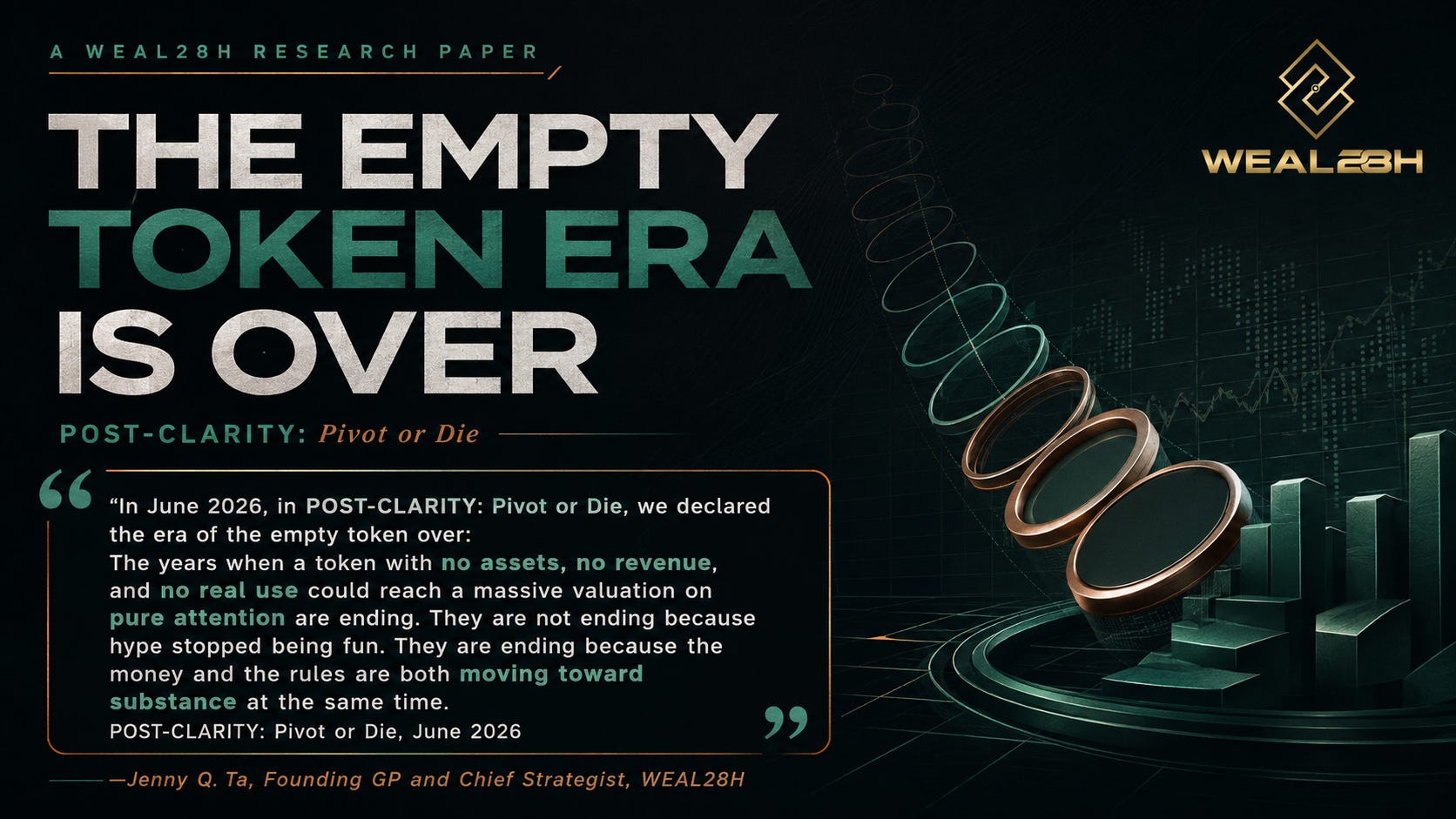
In June 2026, in POST-CLARITY: Pivot or Die, we declared the era of the empty token over:
The years when a token with no assets, no revenue, and no real use could reach a massive valuation on pure attention are ending. They are not ending because hype stopped being fun. They are ending because the money and the rules are both moving toward substance at the same time. —POST-CLARITY: Pivot or Die, June 2026
On our industry-informed reading, paid listings of that asset class were part of the business model to which BitMart was exposed. The empty token did not vanish; much of its distribution migrated onchain, away from paid centralized listings. We published the repricing mechanism a month before the wind-down; the pipeline’s migration is how it reached the venue layer.
The same June paper made a structural forecast about consolidation, using the cloud computing precedent:
Before Amazon launched AWS, plenty of small, scrappy hosting companies ran the web’s servers. Once a giant offered cloud at scale, most businesses moved their websites and data to the giants, AWS first, then Microsoft and Google, and the small providers were largely wiped out or pushed into niches. —POST-CLARITY: Pivot or Die, June 2026
We applied that mechanism to blockchains. It applied equally, and faster, to the venues: trust, reliability, compliance, and institutional weight consolidating activity onto a few giants while the small providers get wiped out or pushed into niches. And the June paper’s closing forecast, that the native-crypto era would rhyme with the dot-com crash, where roughly half the companies were gone within a few years while a smaller group with genuine substance came to dominate, is now playing out at the venue layer in real time.
One month later, the exchanges whose business was the empty-token economy began announcing their exits. We did not call the names, we did not time the wave, and the June analogy was written about chains rather than venues; extending it to the venue layer is this paper’s step, not the June paper’s. What the series published, with dates, was the framework. Events then filled it in.
VI. The Survivor Scorecard
If four structural forces are compressing the venue layer, then survival is not about brand or size. It is about structure. From the two autopsies, five questions determine which side of the consolidation a venue sits on:
Revenue diversification: does the venue earn meaningfully outside spot and derivatives trading fees?
Regulated non-crypto business lines: does it operate licensed securities, brokerage, payments, or banking activity that stands on its own?
Native-token dependence: how much of the venue’s economics, balance sheet, and user incentives run through its own token? Reflexivity between a venue and its own token is, in our view, the single most dangerous structure this consolidation has exposed: BMX lost more than half its value and BMEX approached functional insignificance the day their platforms announced closure.
Liquidity share: is the venue a place liquidity concentrates toward, or drains from?
Regulatory posture: where does it hold licenses that matter, MiCA in Europe, meaningful United States licensure, and how clean is its supervisory standing?
What follows applies those five questions to six named venues using public facts only. We predict nothing about any named firm. The facts are cited in the Sources section; the framework is ours; the conclusions are the reader’s to draw.
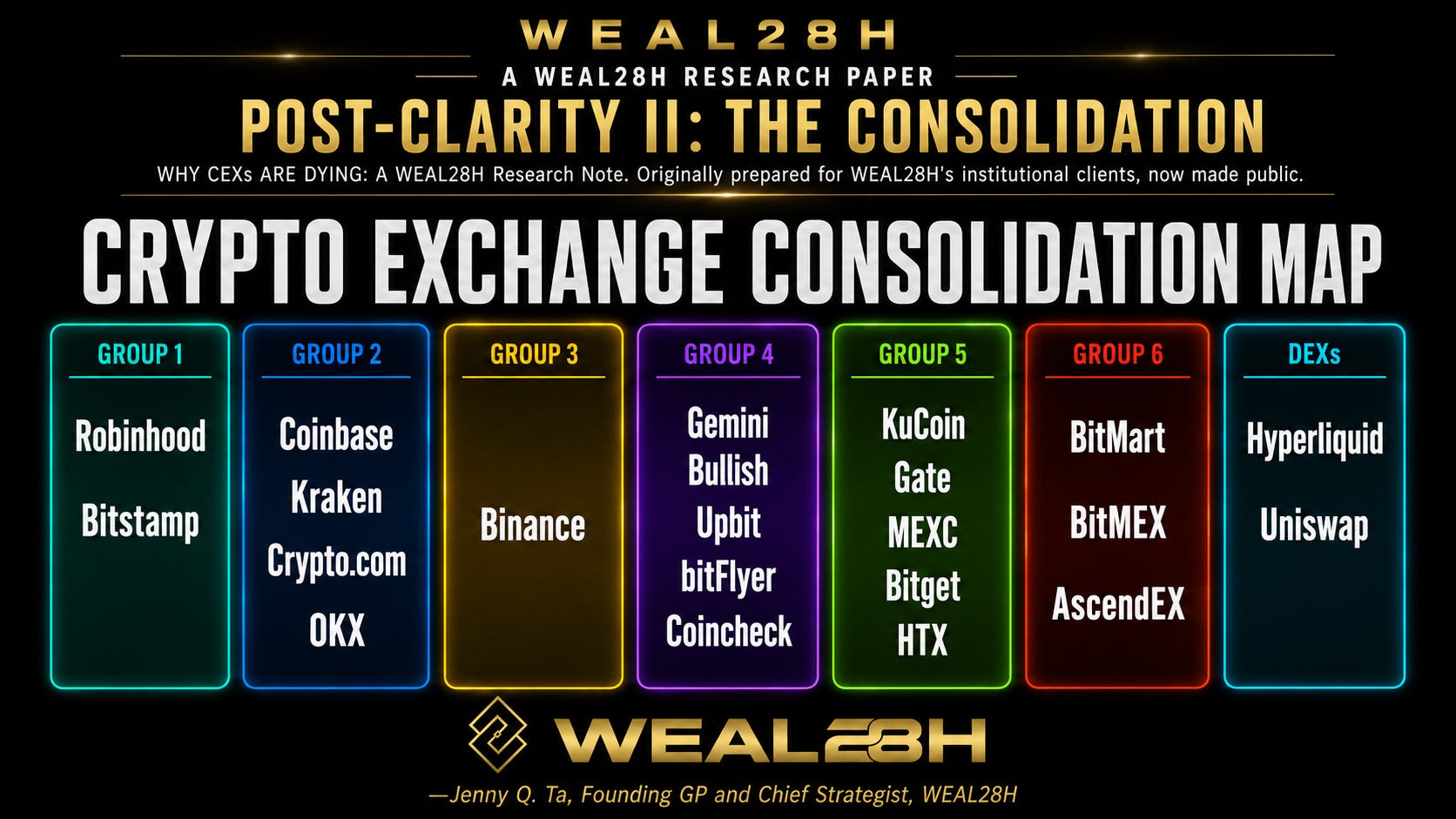
Robinhood
The survivor archetype, and not originally a crypto exchange at all. Crypto is one revenue line inside a diversified, publicly listed, regulated brokerage. In 2026 Robinhood expanded tokenized equities beyond Europe, has described prediction markets as among its fastest-growing segments, operates event contracts with regulated partners including a unit of Interactive Brokers, and was reported in late July to be in discussions with Crypto.com on a prediction-market partnership. No native fee-discount token. On our framework, Robinhood is not surviving the consolidation so much as demonstrating the destination: a brokerage that added crypto, rather than an exchange trying to become a brokerage.
Coinbase
The same convergence from the other direction: a regulated, publicly listed United States company adding securities exposure to crypto. In June 2026, Coinbase announced tokenized stocks with onchain dividend payments and, notably, announced plans for full shareholder voting rights, ahead of a planned non-United States launch; these are stated product intentions, and the complete legal and ownership mechanics had not been publicly detailed as of this writing. It holds MiCA authorization in Europe. Diversified revenue across custody, staking, USDC economics, its Base network, and institutional prime services. On our framework: high diversification, credentialed regulatory posture on both sides of the Atlantic.
Kraken
The most aggressive venue-to-securities-firm conversion in the industry. Kraken launched xStocks tokenized equities in June 2025, reached 100 fully backed tokenized United States stocks and ETFs with over 25 billion dollars in transaction volume, targets over 500 listings by end of 2026, acquired Backed Finance, the xStocks issuer, in December 2025, introduced 24-hour perpetual futures on tokenized United States stocks in February 2026, partnered with Nasdaq on distribution of tokenized stocks outside the United States, and in July 2026 began expanding xStocks to Hong Kong, United Kingdom, and South Korean equities. MiCA authorized. Valued at roughly 20 billion dollars in its most recent raise. On our framework: a crypto exchange systematically rebuilding itself as securities infrastructure.
Crypto.com
On July 16, 2026, Crypto.com announced a 400 million dollar strategic investment from Citadel Securities at a 20 billion dollar valuation, its first institutional funding round in a decade, with the capital earmarked for expansion into tokenized securities and derivatives, including a tokenized stocks launch planned within its core app. The strategic logic is explicit: tokenized securities markets need price formation, liquidity depth, and market-making capacity, which is what Citadel Securities brings. On our framework: a consumer-scale venue that just anchored itself to Tier 1 traditional market-making infrastructure, and the clearest single data point that Wall Street now treats surviving exchanges as future market infrastructure rather than as a separate industry.
OKX
Mid-transition. In June 2026, OKX launched 13 MiFID-regulated X-Perp markets for eligible European traders covering the Magnificent 7 equities, SPY, QQQ, gold, silver, and WTI and Brent crude. The products are five-year expiry futures that use periodic funding mechanics to track their underlying markets, rather than conventional perpetual swaps, and OKX targeted Europe first because the regulatory framework there is clearer. MiCA authorized. On our framework: executing the same exchange-to-broker conversion as the leaders, with its regulatory center of gravity in Europe and the conversion still in progress.
Binance
The most complex case on the board, and the one where we stay most strictly on the public record. The facts. Binance reported 300 million registered users and 34 trillion dollars in trading volume across all products in 2025, held approximately 34.9 percent of derivatives volume among the top ten exchanges measured by CoinGlass in the first quarter of 2026, and in December 2025 became the first crypto exchange to secure a global platform approval from Abu Dhabi’s ADGM Financial Services Regulatory Authority. It is, by scale, the largest exchange in the world.
Also the facts. On June 24, 2026, Binance withdrew its MiCA license application with Greece’s Hellenic Capital Market Commission, six days before the European Union’s July 1 authorization deadline. Reuters reported on June 16, citing two sources, that the Greek regulator was preparing to reject the application; Binance disputed that account. Without MiCA authorization, Binance cannot operate as an authorized crypto-asset service provider in the European Union after July 1, 2026. It halted new European Union registrations and notified users in France, Italy, Poland, and Spain of service restrictions, while stating that user assets remain safe and withdrawable. ESMA instructed unauthorized providers to take immediate steps to wind down their European Union activities. Binance says it remains committed to Europe, plans to reapply, and expects to return in the coming months. Meanwhile its three largest rivals, Coinbase, Kraken, and OKX, are authorized inside the bloc. Separately, Binance operates under a United States Department of Justice resolution requiring ongoing compliance obligations over a five-year period, and its native token BNB, while the fourth largest crypto asset at roughly 78 billion dollars in market capitalization in early July 2026, trades far below its all-time high near 1,370 dollars. Binance originated BNB and much of the token’s utility runs through Binance’s own fee and product ecosystem, which ties the venue’s franchise and its token together. One structural distinction is owed here: BMX and BMEX were much more tightly tied to their respective exchanges, while BNB also powers transactions and governance on BNB Chain, a major smart-contract network. That gives BNB utility beyond the Binance exchange and makes the comparison imperfect. Binance’s corporate balance-sheet holdings of BNB are not established by public disclosure, and we make no claim about them.
To summarize the record rather than opine on it: the public data above show the largest reported scale among centralized venues coexisting with an extensive documented regulatory record in core markets, including the absence of MiCA authorization while its three largest rivals are authorized and a five-year Department of Justice compliance framework, and a meaningful linkage between the venue’s franchise and its own token, the same structural linkage the BMX and BMEX collapses exposed at far smaller scale, with the BNB Chain distinction noted above. On the record, scale is the countervailing factor, and Binance reports more of it than any centralized rival. This paper presents that record as data, not as endorsement or criticism; nothing here is intended to promote Binance or any venue, and consistent with our direction-neutral standard we take no position on the company. Whether scale outruns structure is an open question this consolidation will answer, and we make no prediction about how it resolves.
VII. The Vulnerable Archetype
We will not publish a list of venues we expect to close, and readers should be skeptical of anyone who does. What we will publish is the profile, because the two autopsies and the four forces define it precisely. A venue carries maximum consolidation exposure when it matches most of the following: offshore or lightly licensed, with no MiCA authorization and no meaningful United States licensure; revenue concentrated in spot trading fees and token listing fees; a native fee-discount token that doubles as balance-sheet exposure; no regulated non-crypto business line; declining liquidity share; and no credible path to the tokenized-securities conversion the survivors are executing, because that conversion requires exactly the licenses, capital partners, and compliance infrastructure the profile lacks.
One structural feature deserves its own sentence, stated about no venue in particular: any venue whose viability depends on continuously demonstrated reserves carries run risk as a structural feature, because exchanges do not only fail when someone finds a hole; they can fail when enough participants fear there might be one. Trust reflexivity is a mortality channel of its own, and it operates independently of whether any hole exists.
Any reader can apply that profile to any venue using public information: licensing registers are public, token dependence is visible on-chain and in disclosures, and volume share is tracked by multiple data providers. Our category-level view, stated as a forecast and falsifiable: the wind-down wave that took BitMart, BitMEX, and AscendEX is the beginning of this consolidation, not the end of it, and additional mono-line venues matching this profile will announce orderly exits within the next 24 months. We name no candidates, and this forecast asserts nothing about any specific firm.
VIII. The Moat Inverted
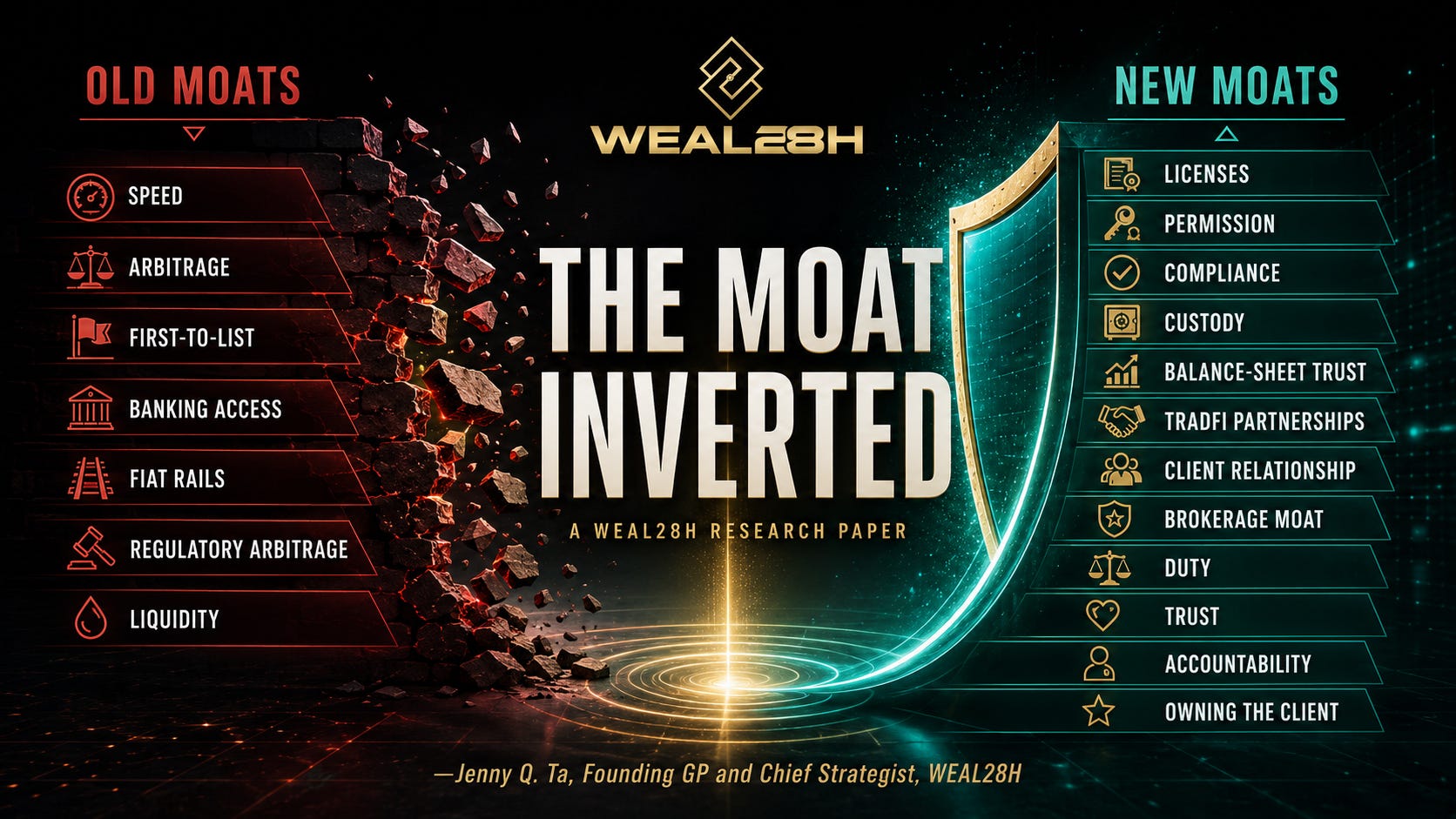
Step back from the scorecard and one pattern explains all of it: the old moat and the new moat are almost perfect opposites, and that inversion is the whole story of the consolidation.
The old CEX moat, in the 2017 to 2021 era, was speed and arbitrage. Being the first place a new token appeared was a moat, because listings were the product. Banking access was a moat, because when banks would not touch crypto, an exchange with working fiat rails held something scarce. Regulatory arbitrage was a moat, because offshore venues could offer leverage and products that regulated ones could not; BitMEX’s entire franchise was the perpetual swap plus 100x leverage, offshore. And liquidity was a moat, as it always is. Notice what the first three have in common: they were moats made of what the industry lacked. Scarce banking, scarce regulation, scarce access to new assets. Moats built on scarcity that was always going to be temporary.
Then every one of them evaporated. Listings commoditized and an increasing share of the paid-listing pipeline moved from centralized exchanges to onchain rails, so first-to-list became worthless. Banking access widened until every fintech had fiat rails, so on-ramps became table stakes. Regulatory arbitrage flipped from asset to liability: the offshore posture that let BitMEX print money in 2019 is the same posture that locked Binance out of the European Union in 2026, and spot ETFs let retail buy Bitcoin through an ordinary brokerage account without ever touching an exchange. The only old moat that survived is liquidity, and liquidity concentrates, which is exactly why the venue count is collapsing toward a handful of giants.
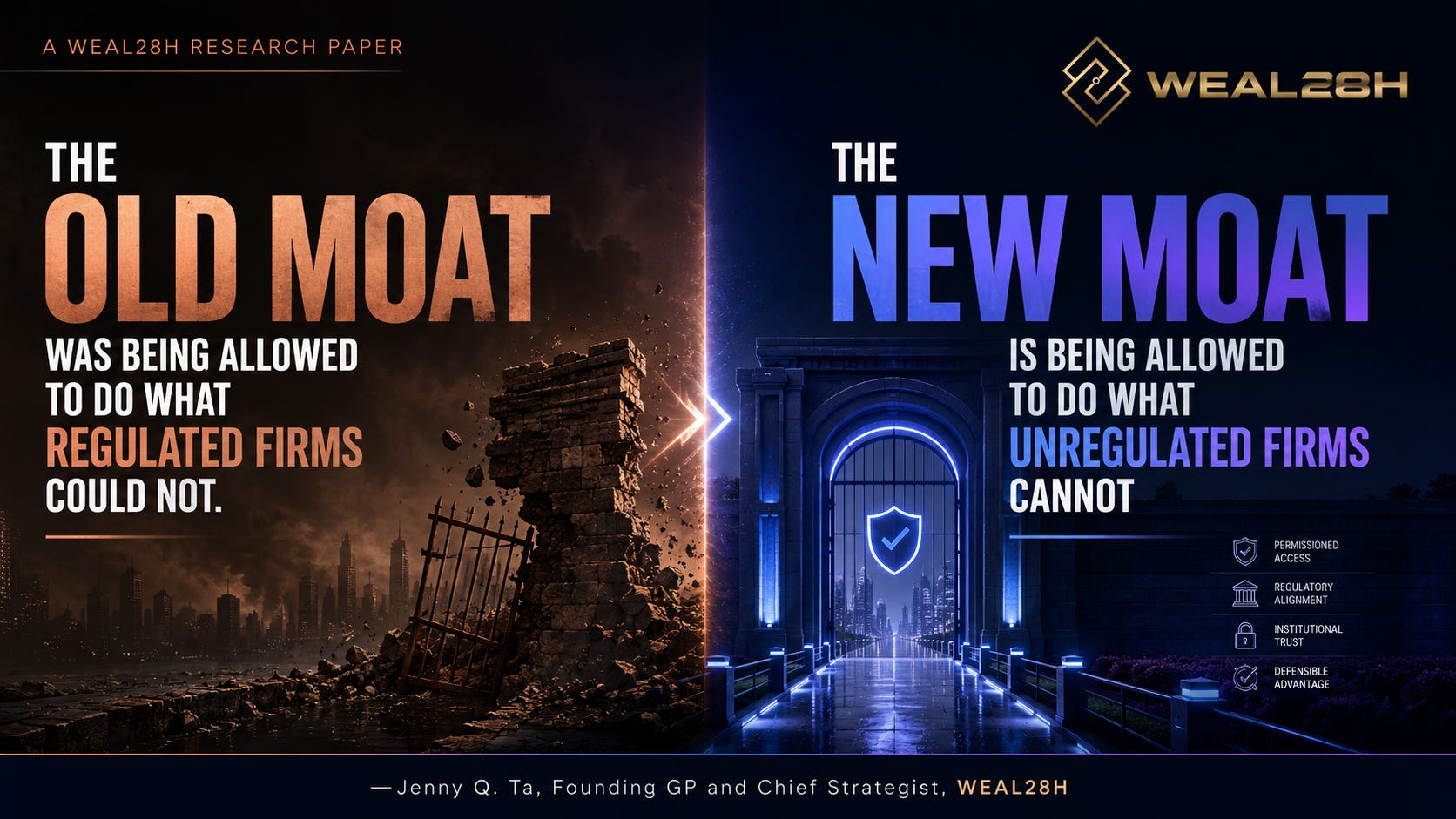
The new moat is the mirror image: it is made of what the industry now lacks, which is permission, duty, and trust. Look at what every survivor in the scorecard actually has. Licenses that took years and fortunes to obtain, MiCA authorization and United States registrations, expensive, slow, and impossible to fast-follow, which is precisely what makes a moat. Compliance infrastructure as a capability rather than a cost center, which is our May paper’s line coming true: compliance is the moat. Custody and balance-sheet trust, ideally with public-company transparency and no reflexive dependence on a native token. Traditional-finance plumbing partnerships that cannot be replicated by hiring: Citadel Securities inside Crypto.com, Nasdaq beside Kraken. And above all, the client relationship across asset classes: the account where someone holds their stocks, their tokens, their tokenized treasuries, and their cash in one place. That last one is the brokerage moat, and it is the deepest of all, because clients consolidate accounts the way liquidity consolidates venues.
Compressed to one line: the old moat was being allowed to do what regulated firms could not. The new moat is being allowed to do what unregulated firms cannot. The extraction era’s moat was scarcity of access. The new era’s moat is scarcity of accountability: the license, the duty, and the trusted relationship, the one thing that cannot be forked, airdropped, or offshored. That is why the moat migrated one layer up the stack, from operating the venue to owning the client, and why the forecast in Section XI lands where it does: whoever carries the relationship and the duty owns the era.
IX. Venue Risk and Protocol Risk: What the Shutdowns Teach Token Projects
There is a second-order lesson in the BitMart wind-down that most coverage missed. When an exchange closes, every token listed there loses a liquidity venue through no fault of its own. Holders must withdraw by a deadline. Projects that paid for those listings watch the distribution they bought evaporate. Exchange shutdown risk is a risk that CEX-listed tokens carry on someone else’s balance sheet, and 2026 just repriced it.
The contrast is structural, and it deserves honest treatment in both directions. A token native to decentralized exchanges pays no listing fees, cannot be delisted by a corporate wind-down, and carries no custody exposure to a venue’s balance sheet; its contracts persist as long as the underlying chain does. Decentralized venues are also gaining share through this consolidation: Hyperliquid entered the top ten derivatives exchanges in the first quarter of 2026, the first decentralized perpetuals venue to do so, with quarterly volume estimated near 492.7 billion dollars by one data compilation; estimates vary materially by provider, some higher.
But decentralization is not immortality, and we will not pretend otherwise. The 2026 shutdown lists include decentralized exchanges and DeFi protocols by name, among them Loopring and Parsec, and the DEX aggregator Odos announced permanent shutdown by July 30, 2026. Decentralized venues die differently: the team and interface can shut down while the contracts persist, but a contract with no liquidity providers and no maintained interface is functionally dead even if technically permanent. And every DEX-native token inherits two risks our June paper spent a full section on: the chain underneath it, and the liquidity providers who can leave at will. The precise statement is this: DEX-native positioning removes the two failure modes this consolidation wave is exposing, venue counterparty risk and listing-fee dependence, and replaces them with chain risk and liquidity risk. Different mortality. Not absence of mortality. In 2026, venue mortality is the one actually killing things.
Disclosure, and a worked example, kept deliberately brief: WEAL28H backs Tetherball (TBALL), a small treasury-heavy token that has, since inception, chosen never to pay for centralized exchange listings and to exist only on decentralized venues. We hold a financial interest in TBALL and benefit if it succeeds, so weigh this example accordingly. We cite it for one narrow reason: it is a live illustration of the structural trade described above, accepting chain, contract, and liquidity risk in exchange for no centralized listing-venue exposure, a trade that the events of July 2026 have made look considerably less contrarian than it did when it was made. That is a structural observation, not a claim about TBALL as an investment, and TBALL remains subject to every risk our prior papers describe for treasury-concentrated, thin-float tokens.
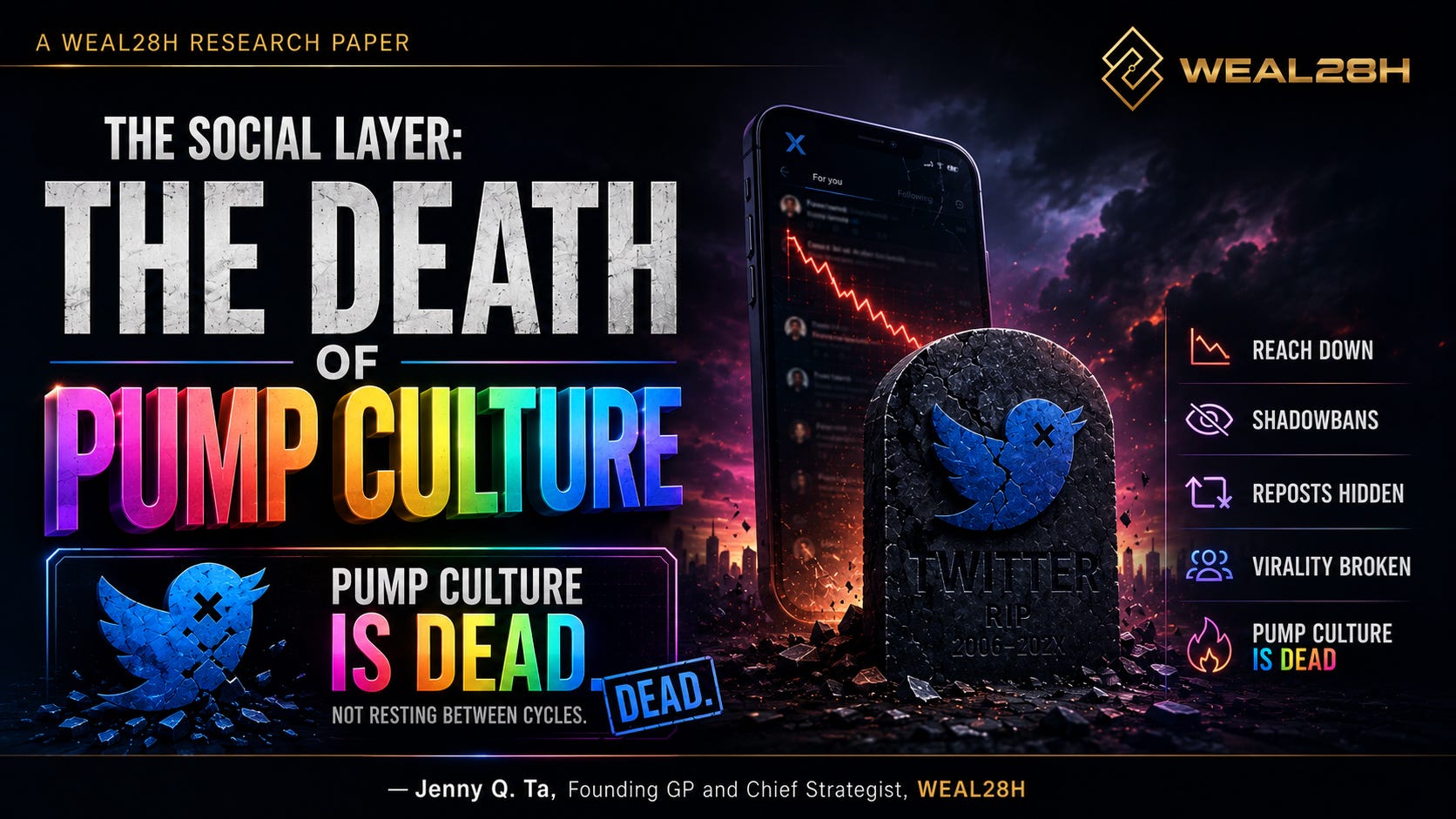
X. The Social Layer: The Death of Pump Culture
This section is different from the rest of the paper, and I want to label it honestly before you read it. What follows is my own read, built on operating experience rather than a data series, because no data series exists for culture. The observations below reflect the accounts I personally operate and monitor and should not be read as a statistically representative study of the platform. I have run crypto-native accounts and watched this industry’s social machinery from the inside for years, and I believe a force this paper has not yet named is doing significant quiet work alongside regulation, liquidity, and funding: the distribution layer of crypto culture has weakened, and much of that weakening occurred on Twitter.
Crypto’s attention economy always ran on a hierarchy, and the hierarchy always started in the same place. Twitter first. Reddit second. The private layers, Telegram and WhatsApp, downstream of both. Every mania of every cycle ignited on Twitter and spread outward, and the purest specimen was 2021. BUY DOGECOIN did not need marketing spend, a research report, or even an exchange listing push to reach the entire market. It needed one mechanic: the retweet. One tap propagated the original post, at full fidelity, with all of its accumulated momentum, onto the feed of every follower of every account that touched it. Likes and retweets compounded on a single object, and a single viral post could land on effectively every feed in the market within hours, at zero cost, permissionlessly. That mechanic was pump culture’s engine, and everything else, the exchange listings, the influencer economy, the meme-coin manias, was built on top of it.
That engine began losing compression after the platform changed ownership in late 2022. Crypto-native accounts have widely reported degraded reach, downgrades, and what users describe as shadowbans in the years since, an experience consistent with what I have observed across accounts I operate and follow. I state this carefully: the platform describes its changes in product and content-integrity terms, ranking systems are opaque from the outside, and I make no claim about intent or about any particular account’s treatment. What I can report is the observable result: the frictionless crypto virality of 2021 became harder to reproduce with each passing year, and the culture’s ignition layer ran progressively colder.
Then, this month, Twitter separated reposts from original posts on profile pages, moving them into a dedicated Reposts tab. Understand what that does in practice. In my experience, profile visitors scroll the main Posts timeline and stop there; few ever open a separate repost archive. So an ordinary retweet now disappears, for profile purposes, into a page most visitors will never open, and a quote-tweet has become the most reliable way to give a post the profile exposure a retweet used to deliver. A quote-tweet is a structurally different object: it creates a new post that starts from zero engagement instead of compounding the original’s momentum. For the record, reposts do still appear in followers’ Home feeds per Twitter’s own documentation; the change is to profile presentation, and it stacks on top of years of algorithmic ranking that had already made follower-driven distribution unpredictable. Across accounts I operate and follow, repost-led cascades have become harder and harder to reproduce. That is an operating observation from my own accounts, not a platform-wide study.
Put in this paper’s terms, crypto’s attention layer has become less predictable and less frictionless than it was in 2021. That evidence does not establish the broader cultural conclusion by itself, but it weakens the distribution assumptions on which listing-driven token launches relied. Regulation, liquidity concentration, listing economics, and funding are this paper’s documented forces. The social layer is a fifth, qualitative hypothesis, grounded in operating experience and presented accordingly.
So here is my read, and I will say it plainly, as my own personal opinion, formed from more than a decade living on Crypto Twitter, watching every mania ignite, spread, and monetize through the same machinery: pump culture is dead. Not resting between cycles. Dead. Token issuance survives, as Section III says; what died is the frictionless ignition layer that turned issuance into market-wide mania, and cultures do not survive the death of their mechanics. And understand what follows from that: crypto without pump culture is not crypto as we knew it. The crypto of 2017 through 2021, the crypto that ran on retail mania and viral momentum, is dead with it; what carries the name forward is a different industry, regulated, institutional, and built on duty rather than hype. Attention in the next cycle will route through algorithmic feeds that reward native content, through private channels that do not scale, and through institutions that buy distribution rather than catch it. That is one observer’s conviction, not a data series, and I have labeled it as such. But if I am right, it is one more reason the venues built to monetize retail token mania are not coming back when price recovers, and one more reason the future this paper forecasts belongs to the client-owning intermediaries rather than the attention merchants.
XI. The Forecast: The Brokerage Era
Every paper in this series ends with a forecast, and this one writes itself, because in the days after the shutdown announcement, a departing senior executive at one of the closing venues asked us plainly: where do we go next? This section is our public answer, to that executive and to the several hundred experienced operators the consolidation is about to set loose. It is also, we believe, the map of where digital asset market structure goes from here.

First, the wrong answer
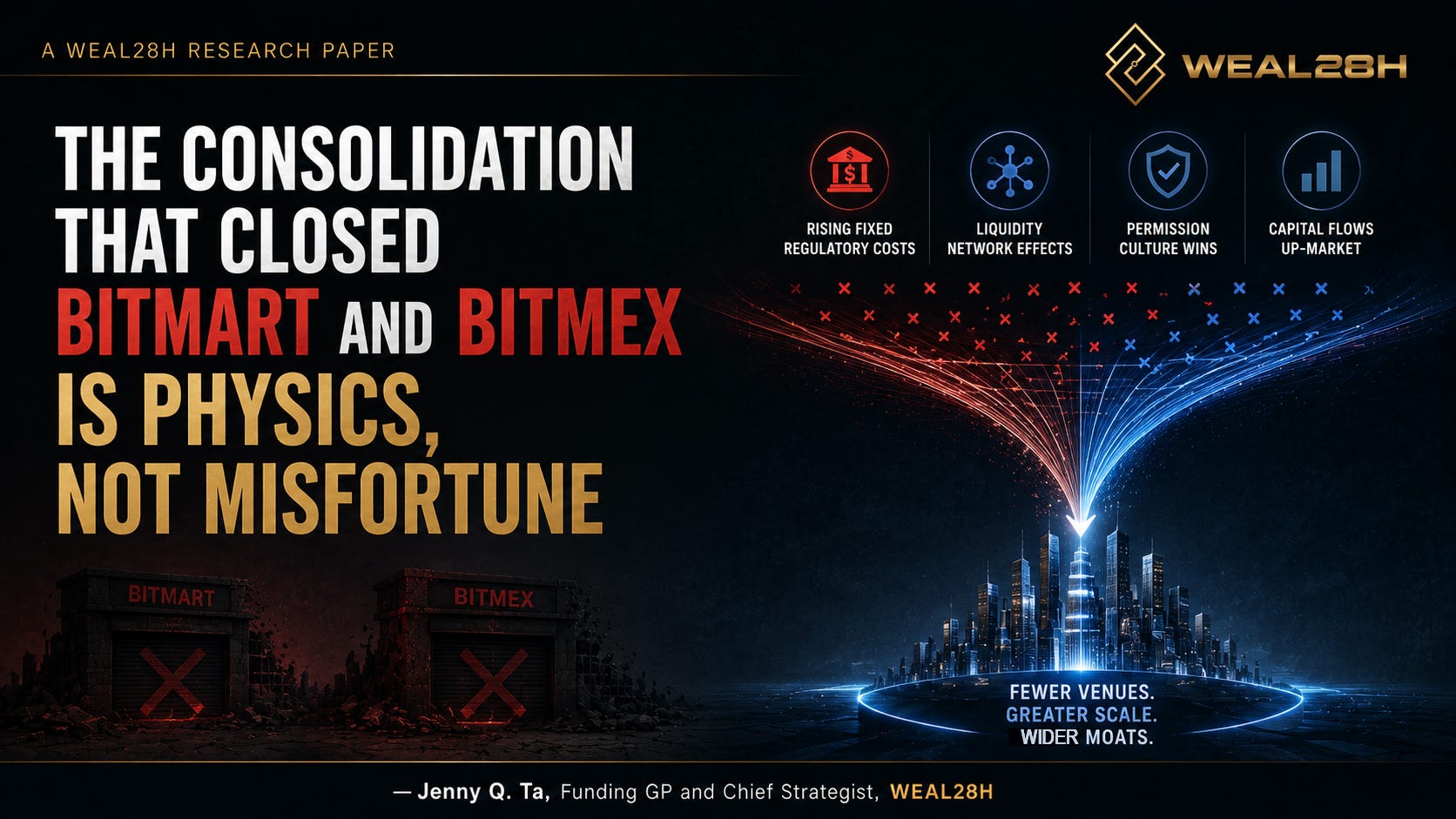
Do not build another unregulated exchange. At the centralized venue layer, permissionless is dead; permission culture has taken over, and permission is now the product. Every survivor in the scorecard proves it, and Section IX describes the different physics that govern decentralized venues. The consolidation that closed BitMart and BitMEX is physics, not misfortune: liquidity network effects plus rising fixed regulatory costs converge the centralized venue layer toward a handful of giants, with the same broad forces that drove operator-level consolidation in equities. Raising capital in 2026 to launch another mono-line trading venue is founding a small hosting company the year after AWS launched. Our June paper published that analogy about chains. It applies with more force to venues.
The structural answer: build the layer crypto never built
Mature market structure in equities has a small number of venue operator groups and, across broker-dealers, advisers, and clearing and custody providers, thousands of intermediary firms above them. Crypto has had the inverse: hundreds of venues, a thin institutional intermediation layer, and no regulated introducing-broker and agency-execution network of equities-like breadth. As the venue layer consolidates to its natural size, the missing layer becomes the opportunity, and the operators leaving the closing venues carry the scarcest credential in the industry: they have run regulated crypto market machinery from the inside, including, for the wind-down teams specifically, the rarest credential of all, executing a regulated venue wind-down designed to return customer assets through an orderly process. Four destinations, in descending order of our conviction:
The introducing and agency layer. Someone will build the digital-asset equivalent of the introducing-broker network and the agency execution desk: firms that own institutional client relationships and route flow across the surviving giant venues, without operating a venue or custodying assets. Think of it this way: the airlines consolidated into a handful of majors, but the travel business did not die; it moved to the agencies, corporate travel desks, and booking platforms that own the traveler and route them onto whichever airline fits. Nobody needs to own an airline to own the client. Our May paper named introducing broker arrangements as a survival path for mid-tier intermediaries; we now extend it as the primary founding opportunity of the post-consolidation era. WEAL28H’s own recent experience is instructive: in institutional discussions with a United States exchange this year, we found no introducing-broker framework existed at all; the only door offered was principal-customer onboarding. Crypto has prime brokers, OTC desks, custodians, and broker-infrastructure firms. What it does not have is a regulated introducing-broker and multi-venue agency-execution layer of equities-like breadth. That specific layer is not underbuilt. It is unbuilt. Traditional finance backers understand this model natively, because they invented it.
Tokenization operations for traditional finance. Our May paper argued the architecture’s largest beneficiaries are the institutions bringing regulated finance on chain; our June paper forecast that the next dominant chains arrive from institutions. Think of it this way: when industry electrified a century ago, firms did not each become power companies; over time, most came to rely on specialized infrastructure and the people who knew how to run it. The banks entering digital assets are the factories, and the exchange operators walking out of the closing venues are the people who know how to run the plants. Those institutions now need people who have actually operated digital asset venues, custody, and onboarding at scale, and on our estimate, only a small global pool of such operators exists, with a meaningful cohort just set loose by these closures. Our expectation: within 18 to 24 months, bank digital-asset units and exchange alumni converge through hiring, acqui-hires, or bank-backed ventures that operate venue and custody infrastructure for institutions that want the capability without building it.
Regulation as product. The compliance fixed cost that crushed the mid-tier is, from the other side of the table, a moat someone sells. Recurring payroll and tax complexity became a service industry once; the burden that crushes a small operator becomes the product a specialist sells at scale, and crypto’s compliance floor will do the same. Settlement infrastructure, licensing-in-a-box, compliance-as-a-service: the operators who just watched exactly which costs killed their employers are uniquely qualified to sell the antidote, and our May paper already identified compliance infrastructure as the second-derivative trade of the entire architecture.
The wind-down practice. The contrarian call. Ninety-nine shutdowns in 2026 and the cycle is not finished. Nobody dreams of running a demolition company, but every building boom eventually creates demand for demolition, remediation, and rebuilding, and Wall Street long ago turned corporate failure itself into a lucrative, permanent industry, with entire restructuring desks and advisory firms living on it. Crypto now needs its equivalent: orderly wind-downs, asset-return logistics, treasury unwinds, token migrations. The teams executing the BitMart and BitMEX closures are, involuntarily, among the small number of operators gaining direct experience in large-scale crypto-venue wind-downs. The first firm to institutionalize that expertise could find a deep pipeline and limited competition.
A note on scope before the arc: the regulatory architecture of this intermediary layer is substantial and unresolved, including entity classification among broker-dealer, introducing broker, adviser, and FCM categories, capital, custody, and best-execution requirements, and which digital assets each structure may lawfully handle. That blueprint is the subject of forthcoming WEAL28H work; this paper makes the structural case, not the operating manual.
The arc, completed
Step back and the whole 2026 series points at one destination. The assets are tokenizing (our tokenized stocks and tokenized real estate papers). The rails are going to regulated incumbents (CLARITY, May). The empty-token economy is repricing, and much of its distribution has moved onchain (POST-CLARITY, June, extended by this paper). The venues are consolidating and converting into brokerages (this paper, and visibly: industry reporting now describes OKX, Kraken, and Binance as racing to become full-service brokers as core trading revenue declines). Every movement converges on the same shape: crypto market structure is becoming equities market structure. Think of it this way: four rivers are cutting through different terrain, tokenizing assets, regulated rails, a repriced token economy, and converting venues, and every one of them empties into the same sea. What is still missing at the destination is the layer that connects clients to the consolidated infrastructure. The exchange operators of 2020 become the brokerage founders of 2027, just as experienced market-structure operators built the broker-dealer and investment banking firms of the 2000s. I built two of those firms during that earlier transition. That is how I know.
Falsifiable markers
So this forecast can be scored, here is what it predicts, on the record. This is a scorecard, not a vibe: every marker below has a date and a publicly observable result, and if the results do not arrive, we will record the miss. The predictions: within 24 months, at least one major bank or Tier 1 market maker acquires or acqui-hires the institutional team of a shuttered crypto exchange. By 2028, a recognizable introducing-broker and agency-execution layer exists in United States digital assets, with multiple firms whose business is client intermediation across venues rather than venue operation. Concentration continues: the surviving top venues’ share of global volume rises through the cycle, and additional mono-line venues matching Section VII’s profile announce orderly exits within 24 months. And at least one dedicated digital-asset wind-down and restructuring practice launches as a named business. If these do not happen, this paper was wrong, and we will say so.
XII. The Chief Strategist’s Assessment
Every paper in this series ends with my own read, so here it is.
I have now watched two market structures consolidate. The first time, in United States equities after 2000, I was inside it as a market maker and as the founder and CEO of two broker-dealer and investment banking firms with Nasdaq market-making operations. From inside those firms, I watched the venues around us get absorbed or shut while durable value moved to scaled market infrastructure and to the firms that held the clients. The second time is happening right now, in digital assets, and it is running the same script at higher speed. When you have seen the movie before, you stop debating whether the ending changes. It does not. Venue economics and ownership concentrate around a handful of giant operators, and beyond that consolidated core, the durable economics migrate to whoever carries the relationship and the duty.
My assessment, in plain words. The consolidation is early, not late: the venues that closed this year closed because the structure said so, and the structure has not finished speaking. The moat has inverted: the era that rewarded doing what regulated firms could not is over, and the era that rewards doing what unregulated firms cannot has begun. The listing-fee economy was never a business; it was an extraction cycle with an expiration date, and the expiration arrived. The survivors will look less like exchanges every quarter and more like brokerages, custodians, and securities infrastructure, because that is what their own product announcements already describe. And the most valuable thing set loose by this consolidation is not an asset. It is the people: the operators who now carry the scarcest experience in the industry, and who will build the regulated introducing-broker and agency-execution layer crypto has not yet built at equities-like scale. Seventeen years in, with estimated global crypto ownership still below ten percent of the world’s population as of 2025 (one industry estimate counted roughly 741 million owners, about nine percent, with other methodologies producing lower figures), this industry’s growth problem was never the assets. It was the absence of the accountable layer that lets serious capital touch them. That layer is what gets built next.
If I am right, the winners of the next five years are not on today’s volume leaderboards at all. They are the licensed intermediaries being founded right now, some of them by people reading this paper. If I am wrong, the falsifiable markers in Section XI will say so on a schedule, and I will publish the miss the way this series has always promised to. Either way, my conviction is on the record, dated, in one line: the exchange era ended this summer, and almost nobody noticed because it ended quietly.
XIII. The Honest Bottom Line
Two established exchanges announcing commercially framed wind-downs within three days is not a tragedy for the industry. It is the industry growing up. They were not the only exchanges to close in 2026, but the manner of their exit matters. Violent deaths, the Mt. Goxes and FTXs, were signs of an immature market where failure meant customer losses and contagion. Planned wind-downs with published timelines, where execution ultimately matches the announcement, are signs of a maturing industry in which an unsuccessful business can be closed responsibly, by professionals who deserve to land well. To those professionals, including the ones we dealt with directly this year: the consolidation is not a verdict on you. It is the market converging on the structure every mature market reaches, and it is handing you, involuntarily, the exact experience the next layer of this industry will be built from.
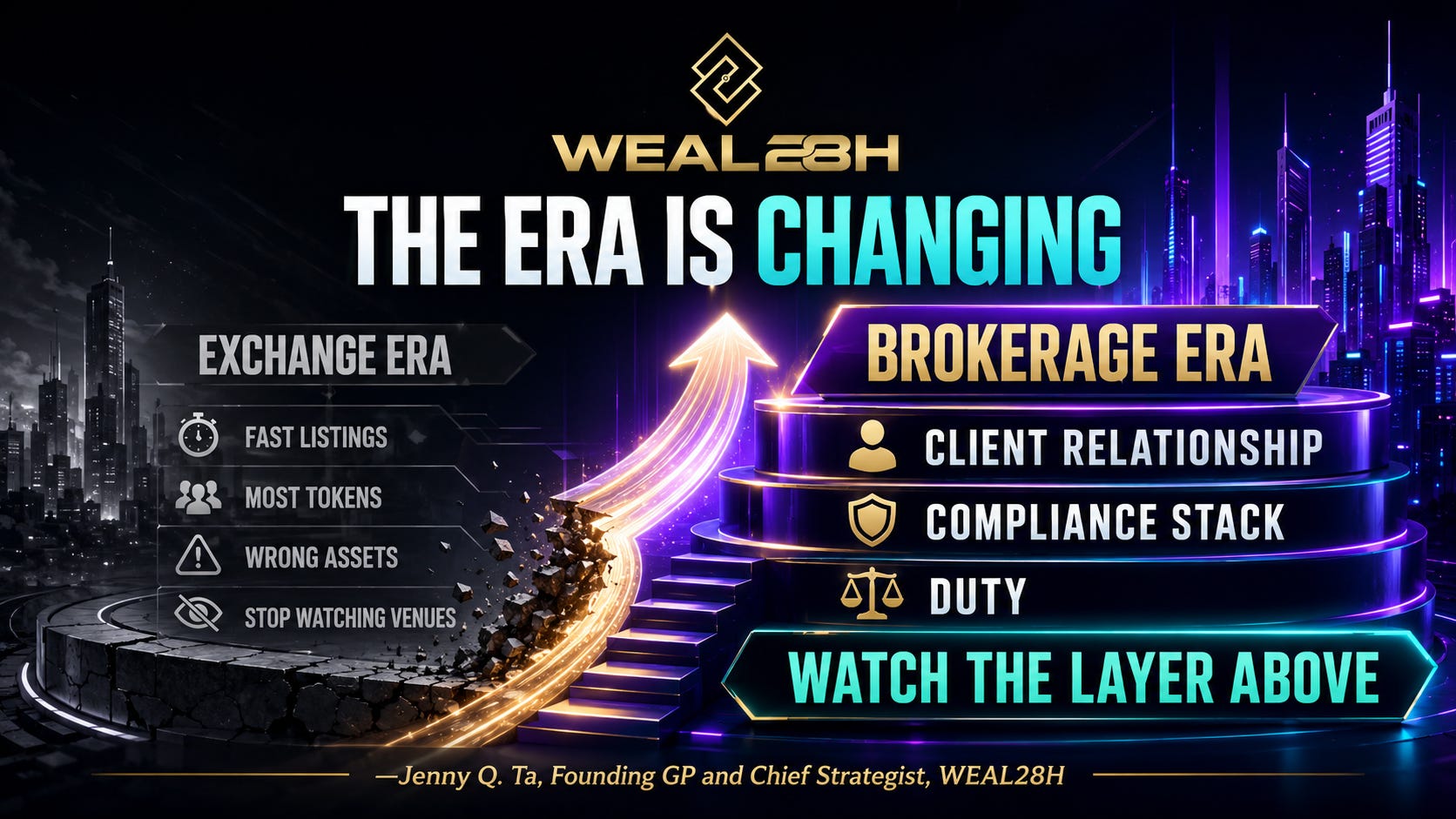
The label on the era is changing. The exchange era rewarded whoever could list the most tokens fastest. The brokerage era will reward whoever carries the client relationship, the compliance stack, and the duty. We wrote in May that most of the market is repricing the wrong assets. We will close this one the same way: most of the market is still watching the venues. Watch the layer being born above them.
About Jenny Q. Ta
Jenny Q. Ta is the Founding GP and Chief Strategist of WEAL28H. She is a former market maker and the founder and former CEO of two registered broker-dealer and investment banking firms with Nasdaq market-making operations. Her work sits at the intersection of capital strategy, market structure, valuation, deal architecture, regulated capital markets, digital assets, fintech, blockchain, AI, early-stage capital strategy, and institutional-scale transaction readiness across the full capital lifecycle.
The advantage behind WEAL28H’s public work is operating experience, not opinion alone. Jenny has operated inside the machinery that prices, distributes, structures, supervises, and sells securities. That is the lens here: separating product language from legal capacity, identifying who carries duty and liability, and mapping the accountability stack before capital, clients, or institutions rely on the model.
About WEAL28H
WEAL28H is a private fund and strategic institutional advisory firm focused on digital assets, fintech, blockchain, AI, regulated capital markets, and institutional-scale capital strategy. We work with investment banks, broker-dealers, banks, asset managers, RIAs, institutional allocators, family offices, founders, and strategic operators on valuation, market structure, capital strategy, deal architecture, M&A readiness, strategic combinations, secondary liquidity, governance, dilution, transaction structuring, transaction readiness, institutional positioning, AI tooling, product workflows, blockchain infrastructure, and technical strategy.
Our work runs across the full capital lifecycle, from capital formation and compliant raise preparation to institutions evaluating large-scale transactions, mergers, acquisitions, market structure, product architecture, and institutional risk. For AI and financial-market products, WEAL28H focuses on the questions that decide whether a claim survives institutional, legal, and regulatory scrutiny: what the product actually does, which entity stands behind it, where the economic incentives sit, what must be disclosed, what must be supervised, and who is accountable when the system is wrong.
WEAL28H’s analysis is direction-neutral. Our views reflect our independent read of product structure, regulatory posture, market structure, governance, incentives, and institutional risk. They are not a recommendation to buy or sell any security, token, fund interest, or financial product, and they do not change based on whether a client is buying, selling, holding, waiting, raising, allocating, building, merging, acquiring, allocating capital, or preparing for a transaction.
To apply this work to your mandate, reach us at vibes@WEAL28H.com or WEAL28H.com.

Disclosure
For informational and educational purposes only. Not legal, regulatory, financial, or investment advice. WEAL28H’s work may include private fund activity, startup backing, strategic institutional advisory, and digital asset projects. Do your own research and consult qualified professionals before acting.
Additional disclosures specific to this note. Nothing in this publication asserts or implies insolvency, financial distress, misconduct, or risk to customer assets at any named company, including Robinhood, Coinbase, Kraken, Crypto.com, OKX, Binance, BitMart, BitMEX, or AscendEX. Statements about named companies are drawn from public sources cited below and reflect the record as of late July 2026; forward-looking statements are category-level opinions about market structure, not predictions about any specific firm. WEAL28H was in institutional onboarding discussions with BitMart US in 2026 that concluded without an agreement; no confidential information from those discussions appears in this piece. Market and regulatory figures are approximate, vary by source, and should be refreshed if material changes occur.
Position Disclosure
As of the publication date, WEAL28H is the backer of Tetherball (TBALL), which is discussed in Section IX as an example of a DEX-native structure. WEAL28H and its principals hold an interest in TBALL and may benefit financially from its success, so that section should be weighed with this interest in mind. Neither Jenny Q. Ta nor WEAL28H holds a position in, or has a financial interest in the price movement of, any other project, token, exchange, or company named in this piece, including Robinhood, Coinbase, Kraken, Crypto.com, OKX, Binance and BNB, BitMart and BMX, BitMEX and BMEX, AscendEX, Hyperliquid, Loopring, Parsec, Odos, Citadel Securities, Interactive Brokers, and Nasdaq. Neither Jenny Q. Ta nor WEAL28H stands to gain or lose based on the price movements of these non-TBALL examples or on whether any transaction involving them occurs. Positions may change without notice, and no obligation to update is assumed. WEAL28H is compensated for producing research and advisory work generally; that compensation is not tied to the views expressed here or to any outcome for any project named, including TBALL.
Sources and References
Primary documents, regulatory materials, and company announcements are given priority wherever available. Reputable journalism is used for reported developments not otherwise available in the public record, with attribution preserved. All citations were reviewed for relevance, accuracy, source quality, and consistency with the public record as of July 29, 2026.
Primary materials
BitMart. Official platform wind-down notice: suspension of new registrations, deposits, and new orders at 01:30 UTC July 26, 2026; cessation of all trading services August 26, 2026; full cessation of operations expected by January 31, 2027; stated reasons of operating conditions, market environment, and future strategic direction; statement that withdrawal services would remain available. July 26, 2026. https://www.bitmart.com/en-US/support/articles/7922665245339/39162120325403/53544595916059
HDR Global Trading Limited (BitMEX). Announcement of permanent platform shutdown at 04:00 UTC September 23, 2026, following a strategic review; reduce-only trading from August 26, 2026. July 2026. https://www.bitmex.com/blog/bitmex-closure
European Securities and Markets Authority. Public statement directing crypto-asset service providers without MiCA authorization to take immediate steps to wind down European Union activities. June 23, 2026. https://www.esma.europa.eu/sites/default/files/2026-06/ESMA75-113276571-1710_Public_Statement_MiCA_transitional_period_ends.pdf
United States Department of Justice and Financial Crimes Enforcement Network. Resolution with Binance Holdings Ltd. and related compliance obligations, including a five-year FinCEN monitorship. November 2023. https://www.justice.gov/usao-wdwa/pr/binance-and-ceo-plead-guilty-federal-charges-4b-resolution | https://www.fincen.gov/news/news-releases/fincen-announces-largest-settlement-us-treasury-department-history-virtual-asset
Kraken. xStocks launch (June 2025); 100 fully backed tokenized United States stocks and ETFs with over 25 billion dollars in transaction volume and a target of over 500 listings by end of 2026; acquisition of Backed Finance (December 2025); Nasdaq distribution partnership; 24-hour perpetual futures on tokenized United States stocks (February 2026); July 2026 expansion toward Hong Kong, United Kingdom, and South Korea equities; and an $800 million raise announced November 18, 2025, valuing Kraken at approximately $20 billion. Kraken announcements and CoinDesk reporting. https://blog.kraken.com/product/xstocks/tokenized-equities-now-available | https://blog.kraken.com/product/xstocks/celebrating-100-xstocks | https://blog.kraken.com/news/backed-acquisition | https://blog.kraken.com/news/payward-partners-with-nasdaq | https://blog.kraken.com/product/xstocks/tokenized-equity-perpetual-futures | https://www.coindesk.com/business/2026/07/22/kraken-parent-expands-tokenized-stocks-to-hong-kong-uk-and-south-korea-equities
Coinbase. Announcement of tokenized equities with onchain dividend payments and announced plans for shareholder voting rights, ahead of a planned non-United States launch. June 16, 2026. https://www.coinbase.com/blog/system-update-take-control-of-your-money-with-coinbase
Crypto.com. Announcement of a 400 million dollar strategic investment by Citadel Securities at a 20 billion dollar valuation, the company’s first institutional funding round, with proceeds directed toward tokenized securities and derivatives. July 16, 2026. https://crypto.com/us/company-news/cryptocom-announces-400-million-strategic-investment-from-citadel-securities
OKX. Launch announcement, June 9, 2026: 13 MiFID-regulated X-Perp markets for eligible European traders covering the Magnificent 7 equities, SPY, QQQ, gold, silver, and WTI and Brent crude, structured as five-year expiry futures with periodic funding mechanics; offered via OKX Europe Markets Limited, regulated by the Malta Financial Services Authority. https://www.okx.com/en-eu/help/okx-to-list-several-x-perps | https://www.okx.com/learn/okx-x-perps-mifid-regulated-crypto-futures-derivatives-europe
X Corp. Help Center, About your For you timeline, describing timeline composition including Reposts appearing in followers’ timelines. Accessed July 27, 2026. https://help.x.com/en/using-x/x-timeline
Reporting and data compilations
Crypto Briefing. BitMart shutdown coverage, including the wind-down timeline, stated reasons, BMX token decline of more than 55 percent, and BitMart’s listing-focused business profile. July 26, 2026. https://cryptobriefing.com/bitmart-bmx-token-crash-exchange-shutdown/
Reuters, CoinDesk, and Yahoo Finance. BitMEX closure coverage, including Kaiko data showing July 2026 daily volume near 400,000 dollars and market share below 0.01 percent, BMEX token decline of over 90 percent to an estimated 497,000 dollar market capitalization, and the absence of an announced balance-sheet hole, announced withdrawal freeze, or bankruptcy filing. July 2026. https://www.reuters.com/business/cryptocurrency-exchange-bitmex-shut-down-2026-07-23/ | https://www.coindesk.com/markets/2026/07/23/bitmex-s-11-year-run-comes-to-an-end-notifies-users-it-is-ending-operations-in-by-sept-23 | https://finance.yahoo.com/markets/crypto/articles/bitmex-token-bmex-crashes-over-125249271.html
RootData, as reported. Tally of 99 crypto project shutdowns in 2026, including BitMart, BitMEX, and AscendEX, across exchanges, wallets, DeFi protocols, and infrastructure; a mixed population cited for breadth, not as an exchange-only sample. July 2026. https://www.rootdata.com/archives/detail/2026%20Crypto%20Dead%20Projects%20List?k=NDU0NzYz
Odos. Announcement that the application would become read-only on July 27, 2026, and that all company-operated services would permanently shut down on July 30, 2026.


TRM Labs. “H1 2026 Crypto Hacks Reach Record High as Losses Fall Below USD 1 Billion.” July 1, 2026. Reporting approximately 972 million dollars stolen across 207 incidents during the first half of 2026. https://www.trmlabs.com/resources/blog/h1-2026-crypto-hacks-reach-record-high-as-losses-fall-below-usd-1-billion
CCData. Exchange Review, April 2026, as reported: combined centralized-exchange spot and derivatives volume down 11.7 percent to 4.61 trillion dollars, the lowest since September 2024; spot volume down 14.0 percent to roughly 1.05 trillion dollars, the lowest monthly figure since November 2023. https://data.coindesk.com/reports/exchange-review-april-2026
Industry reporting, July 2026, describing OKX, Kraken, and Binance as expanding toward full-service brokerage models as core trading revenue declines; Crypto Briefing. “Crypto exchanges expand full-service broker roles as trading revenues decline.” July 2026. https://cryptobriefing.com/crypto-exchanges-expand-full-service-broker-roles/
Robinhood, CoinDesk, Interactive Brokers, and The Wall Street Journal. Robinhood’s tokenized-stock expansion beyond Europe; prediction markets described as among its fastest-growing businesses; event-contract access involving ForecastEx, an Interactive Brokers affiliate; and reported discussions with Crypto.com. 2025 to July 2026. https://www.coindesk.com/business/2026/07/16/citadel-securities-invests-usd400-million-in-crypto-com-valuing-exchange-at-usd20-billion | https://www.wsj.com/finance/currencies/prediction-markets-race-heats-up-as-robinhood-and-crypto-com-hold-talks-9fc211dd
Reuters, Binance, and CoinDesk. Report, citing two sources, that Greece’s Hellenic Capital Market Commission was preparing to reject Binance’s MiCA application, June 16, 2026, an account Binance disputed; with Binance statements and CoinDesk coverage of the June 24, 2026 application withdrawal, the halt of new European Union registrations, service restrictions in France, Italy, Poland, and Spain, Binance’s statements on asset safety and plans to reapply, and MiCA authorization of Coinbase, Kraken, and OKX. June to July 2026. https://www.reuters.com/business/finance/binance-set-lose-eu-licence-bid-permission-offer-services-bloc-sources-say-2026-06-16/ | https://www.reuters.com/business/finance/binance-vows-stay-europe-despite-licence-setback-2026-06-24/ | https://www.binance.com/en/blog/regulation/4457979419755346760 | https://www.coindesk.com/policy/2026/06/26/binance-tells-eu-users-it-will-no-longer-provide-services-after-failing-to-secure-mica-license
Binance. Year-end statement, December 31, 2025, as reported: 300 million registered users and 34 trillion dollars in trading volume across all products in 2025. https://www.binance.com/en/square/post/34813906047033
ADGM Financial Services Regulatory Authority. Announcement of Binance’s global platform approval, December 8, 2025, per the ADGM release and contemporaneous coverage. https://www.adgm.com/media/announcements/binance-becomes-first-crypto-exchange-to-secure-a-global-license-under-adgm-framework-setting-a-new-standard-in-digital-asset-regulation
CoinGlass. First-quarter 2026 derivatives report data, as reported: Binance at approximately 34.9 percent of derivatives volume among the top ten exchanges CoinGlass measured, a set that includes one decentralized venue; Hyperliquid’s entry into that top ten with estimated quarterly volume near 492.7 billion dollars, with materially different estimates published elsewhere. https://www.coinglass.com/learn/2026-q1-mktshare-report-en
Market data compilations. BNB traded in the high-500-dollar range with a market capitalization in the high-70-billion-dollar range in early July 2026, against an all-time high near 1,370 dollars. Market figures vary by timestamp and provider. https://coinmarketcap.com/historical/20260705/ | https://www.coingecko.com/en/coins/bnb
CoinDesk, CryptoSlate, and the Federal Trade Commission. BitMart December 2021 hack of roughly 196 million dollars per PeckShield estimates, drained from Ethereum and BSC hot wallets via a stolen private key across more than twenty tokens; withdrawal suspension and CEO Sheldon Xia’s pledge to cover losses from company funds; the Federal Trade Commission’s August 2022 order concerning BitMart operators Bachi.Tech Corporation and Spread Technologies, described as the agency’s first known crypto-market probe. No claim about the FTC matter’s subsequent disposition is made in this paper. https://www.coindesk.com/tech/2021/12/06/bitmart-ceo-says-stolen-private-key-behind-196m-hack | https://cryptoslate.com/bitmart-ceo-admits-196-million-hack-was-the-result-of-leaked-private-keys/ | https://www.ftc.gov/system/files/ftc_gov/pdf/2223050CommissionPTQOrderBachiTech.pdf
Pop Base (@PopBase) and platform-watcher reports. Documentation of the mid-2026 profile redesign separating users’ original posts and reposts into dedicated tabs. July 2026.


Platform-watcher post (@howfxr) documenting the announced profile redesign, including that retweets would no longer appear in the Posts tab and that a dedicated Reposts tab was coming. May 2026.


Crypto.com Research, as reported. Estimate of roughly 741 million global crypto owners in 2025, approximately nine percent of world population; other methodologies produce lower figures. https://crypto.com/en/research/crypto-market-sizing-report-2025 | https://mkt-static.crypto.com/%5Bcrypto.com%5D-crypto-market-sizing-2025.pdf
Cyclical-bottoming consensus view referenced in Section II: representative public commentary from market analysts following the July 2026 shutdown announcements, framing the closures as a normal bottoming process comparable to 2022. Characterized at the category level. https://beincrypto.com/bitmart-bitmex-shutdowns-analysts-bottom/
Commodity Futures Trading Commission. Consent order against HDR Global Trading Limited and affiliated BitMEX entities: 100 million dollar civil monetary penalty, with up to 50 million dollars offset by payments made under the related FinCEN assessment. August 10, 2021. https://www.cftc.gov/PressRoom/PressReleases/8412-21 | https://www.cftc.gov/media/6261/enfhdrglobaltradingconsentorder081021/download
Financial Crimes Enforcement Network. Assessment of civil money penalty against BitMEX entities for Bank Secrecy Act violations. August 10, 2021. https://www.fincen.gov/news/news-releases/fincen-announces-100-million-enforcement-action-against-unregistered-futures | https://www.fincen.gov/system/files/enforcement_action/2021-08-10/Assessment_BITMEX_508_FINAL.pdf
United States Department of Justice, Southern District of New York. Guilty pleas of the three BitMEX co-founders to Bank Secrecy Act violations, 2022; guilty plea of HDR Global Trading Limited, July 2024; sentencing including a 100 million dollar criminal fine, January 2025. https://www.justice.gov/usao-sdny/pr/founders-cryptocurrency-exchange-plead-guilty-bank-secrecy-act-violations | https://www.justice.gov/usao-sdny/pr/third-founder-cryptocurrency-exchange-pleads-guilty-bank-secrecy-act-violations | https://www.justice.gov/usao-sdny/pr/global-cryptocurrency-exchange-bitmex-pleads-guilty-bank-secrecy-act-offense | https://www.justice.gov/usao-sdny/pr/global-cryptocurrency-exchange-bitmex-fined-100-million-violating-bank-secrecy-act
Commodity Futures Trading Commission. Consent orders requiring the three BitMEX co-founders to pay 10 million dollar civil monetary penalties each. 2022. https://www.cftc.gov/PressRoom/PressReleases/8522-22
GENIUS Act effective-date provision, per the statute’s text: enacted July 2025; principal obligations effective on the earlier of January 18, 2027 or 120 days after the primary federal regulators issue final implementing regulations. https://www.govinfo.gov/link/plaw/119/public/27 | https://www.occ.gov/news-issuances/bulletins/2026/bulletin-2026-3.html | https://www.govinfo.gov/content/pkg/FR-2026-04-10/pdf/2026-06974.pdf
BNB Chain network documentation: BNB as the native gas and governance asset of BNB Chain. https://docs.bnbchain.org/bnb-smart-chain/overview/
BitMart listing catalog scale: BitMart’s own listed-asset counts (more than 1,900 supported spot assets) and contemporaneous listings activity in the first half of 2026. https://www.bitmart.com/en-US/academy/BitMart-H1-2026-Report
Prior WEAL28H publications quoted
Jenny Q. Ta. CLARITY Is Wall Street’s Bill, Not Crypto’s. LinkedIn, May 2026: https://www.linkedin.com/pulse/clarity-wall-streets-bill-cryptos-here-what-has-bend-who-jenny-q-ta-doqge/ and Substack, May 26, 2026: https://tetherballcoin.substack.com/p/clarity-is-wall-streets-bill-not. Quotations verbatim from the published Substack text.
Jenny Q. Ta. POST-CLARITY: Pivot or Die. LinkedIn, June 27, 2026: https://www.linkedin.com/pulse/post-clarity-pivot-die-jenny-q-ta-on8tc/ and Substack: https://tetherballcoin.substack.com/p/post-clarity-pivot-or-die. Quotations verbatim from the published Substack text.
Equities market consolidation precedent: post-2000 ECN and regional venue consolidation (Island, Archipelago, Instinet, BRUT, regional exchanges) into major exchange operators; author’s first-person operating history; FINRA member-firm counts and adjacent intermediary populations as defined in Section IV. https://ir.thomsonreuters.com/news-releases/news-release-details/reuters-instinet-and-island-complete-merger | https://www.sec.gov/files/rules/proposed/2026/34-105655.pdf | https://www.finra.org/media-center/blog/four-insights-from-finras-2026-industry-snapshot
Love the title :)
This is bigger than exchange closures. Value is moving from owning a matching engine to owning the client relationship, regulatory permissions, and execution flow.
The exchange era may be shrinking, but the market-structure opportunity is expanding.